


EU countries will meet next week to discuss a joint response to travellers from China amid concern over the country's explosion of Covid-19 cases, incoming EU presidency holder Sweden said.
"Sweden is seeking a common policy for the entire EU when it comes to the introduction of possible entry restrictions", the Swedish government said in a statement.
Stockholm, which takes over the rotating EU presidency from tomorrow, said it had called a meeting of the Council's crisis management mechanism IPCR for Wednesday.
"It is important that we quickly get the necessary measures in place", it said.
France, Italy and Spain this week imposed Covid testing requirements. Germany, while saying it saw no need to impose routine tests, is seeking a coordinated system to monitor variants across European airports.
The European Centre for Disease Prevention and Control (ECDC), one of the EU's health agencies, said Thursday that systematic screening of travellers was currently "unjustified".
It cited the level of immunity in Europe and the presence on the continent of the same variants as in China.
The European branch of the International Airports Council said today that imposing restrictions for travellers from China country was "neither scientifically justified nor risk based".
The federation, which represents more than 500 airports in 55 European countries, said the identification of possible new variants that could emerge in China could be detected with genomic sequencing of airport waste water analysis, without the need to test travellers.
Passengers arriving at Spanish airports from China were screened for Covid-19 today, authorities announced.
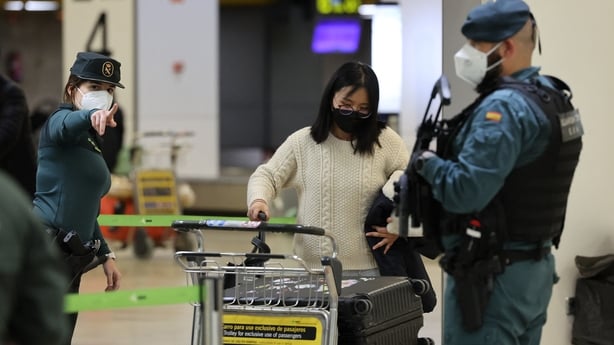
The measure will remain in place until at least 15 February, Spain's health ministry said in a statement, with travellers arriving from China required to undergo a temperature check and a Covid-19 test.
"A major concern lies in the possibility of new variants appearing in China that have not been controlled," Spanish health minister Carolina Darias told a press conference.
"Given the health situation in that country, we know the importance of acting with coordination, but also the importance of acting quickly."
The first flight from China that will be affected by the new rules is scheduled to arrive at Madrid airport on Saturday at 6pm, the ministry's statement said.
Coronavirus infections have surged in China, overwhelming hospitals as the country unwinds hardline controls that torpedoed the economy and sparked nationwide protests.
Morocco will impose a ban on people arriving from China, whatever their nationality, from 3 January to avert any new wave of coronavirus infections, the foreign ministry said.
Thousands of tourists visit Morocco from China every year, usually travelling on flights that come via the Gulf.
Canada has announced a temporary negative Covid-19 test requirement for travellers arriving from China, Hong Kong or Macao.
Those travelling by air will have to present a negative Covid-19, taken no more than two days prior before departure for Canada from 5 January, regardless of nationality or vaccination status.
In an "extremely urgent" memo, the health ministry of The Philippines ordered all ports of entry to heighten surveillance on all respiratory symptoms in all travellers from China, and report intercepted symptomatic passengers.
The Philippines was among the hardest hit by the pandemic, imposing lengthy and strict lockdowns in 2020, but most of the coronavirus curbs were removed earlier this year to allow there opening of the economy.
China is set to lift its travel restrictions on 8 January, which would likely cause a significant rise in people travelling abroad.
In 2019, around 700,000 tourists with Chinese residency visited Spain, according to Spain's tourism ministry.
That figure dropped sharply to about 130,000 in 2020 and 30,000 in 2021, according to the Spanish statistics institute.
