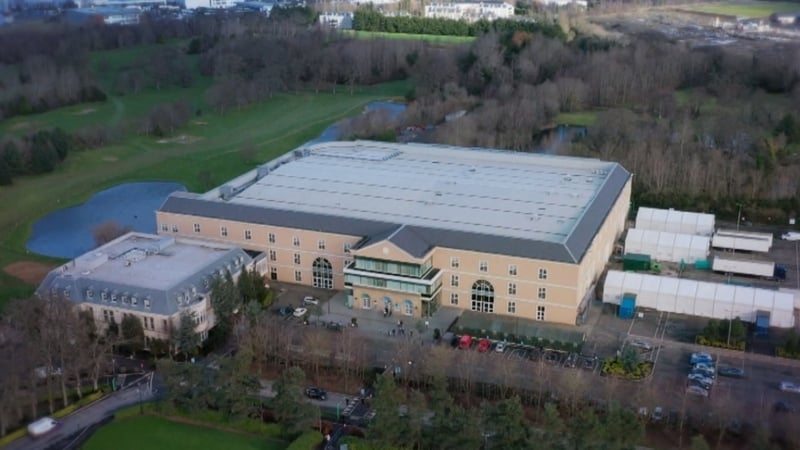

An out-of-hours service will be available to international protection applicants who cannot avail of accommodation at the Citywest transit hub, which is closing to new arrivals over Christmas and early in the New Year.
Alternative arrangements are being made both for international protection applicants over the holiday period and for Ukrainian refugees arriving between 23-27 December and 1-2 January.
A spokesperson for the Department of Children, Equality, Disability, Integration and Youth said that newly arrived international protection applicants "will be assigned to designated accommodation" via the International Protection Accommodation Service (IPAS) duty phone which they said "would be available on a 24/7 basis throughout the holiday period."
The spokesperson said it was "doing everything we can to avoid a situation where people are going without accommodation".
However, RTÉ News understands that the department is making a contingency plan for "where no accommodation is available," something which has happened twice before.
If that happens, RTÉ understands that newly arrived asylum seekers will be advised to "contact ... on a regular basis" an International Protection Accommodation Service (IPAS) email address "for the latest information on any available accommodation".
Asylum seekers who were left temporarily homeless in September and again in October when Citywest was closed to new arrivals were advised to do the same thing.
The International Protection Office, which receives newly arrived asylum seekers on weekdays, will also be closed for much of the Christmas period.
It will be only be open on 28 and 29 December before closing again until 3 January.
RTÉ News has seen a poster that was shared with stakeholders, which advises international protection applicants who "require accommodation urgently" while the International Protection Office is closed to call a freephone number.
At the time of writing this article the freephone number given was the same one as is used by Dublin Regional Homelessness Executive, but callers were offered two separate services, one for those looking to access homeless services and another for international protection applicants.
"While acknowledging the work done by IPAS in 2022, it is essential that people have access to the protection process and accommodation during the holiday period," Nick Henderson, CEO of the Irish Refugee Council said.
"Some people will not have a phone or the English language skills to navigate a free phone number. Translation of notices and proactive identification of people who need particular help will be needed," Mr Henderson said.
A different system is in place for Ukrainian refugees arriving into Ireland during this period.
Newly arrived Ukrainian refugees will go directly to designated temporary accommodation centres and will then be transferred to the Citywest transit hub once it reopens for processing.
Announcing the temporary closure of Citywest to new arrivals over Christmas last Friday, a statement from the department said that state-provided accommodation "is very limited in Ireland at the moment both for Ukrainian Beneficiaries of Temporary Protection and for International Protection applicants" and that this is likely to continue into early January.
The department asked Ukrainian Beneficiaries of Temporary Protection and International Protection applicants who were "in situations of safety not to travel to Ireland, if possible, over the next fortnight and to defer making travel plans to come to Ireland until the New Year".
We need your consent to load this rte-player contentWe use rte-player to manage extra content that can set cookies on your device and collect data about your activity. Please review their details and accept them to load the content.Manage Preferences
Meanwhile, the Director of Ukrainian Action Ireland said he believes Ukrainians will continue to travel to Ireland to seek refuge despite being aware of the issues around accommodation here.
"Ultimately people in Ukraine still do not feel safe and for as long as they don't feel safe they will be trying to go to other countries, Ireland included," Anatoliy Prymakov said.
Speaking on RTÉ's Morning Ireland, he said he does not think many Ukrainians will return home during the Christmas period because of the risks that remain.
"Not a lot of people would be brave enough to undertake the journey to go back, even for a while to see their family and friends," he said.
He said an increase of Russian strikes in recent months has resulted in communication cuts and it can be "agonising" for people waiting to hear from loved ones.
"It is harder to stay in touch with people," he said.
Mr Prymakov said it has been the "worst 10 months of Ukraine so far" as he described how people have suffered a lot, losing their homes, jobs and loved ones.
"Some have lost it all. Certainly, it has been the darkest hour," he said.
"It has certainly been the worst time to be Ukrainian in recent history but on the bright side a lot of Ukrainians who have moved to Ireland, that are staying here, they are really grateful for the support they have received, the people they have met and for the heartwarming welcome they have received in Ireland from the Irish people," he added.
He explained some of the traditions around Christmas for Ukrainians and how they celebrate Christmas Eve on 6 January and Christmas Day on 7 January as the population is largely Christian Orthodox.