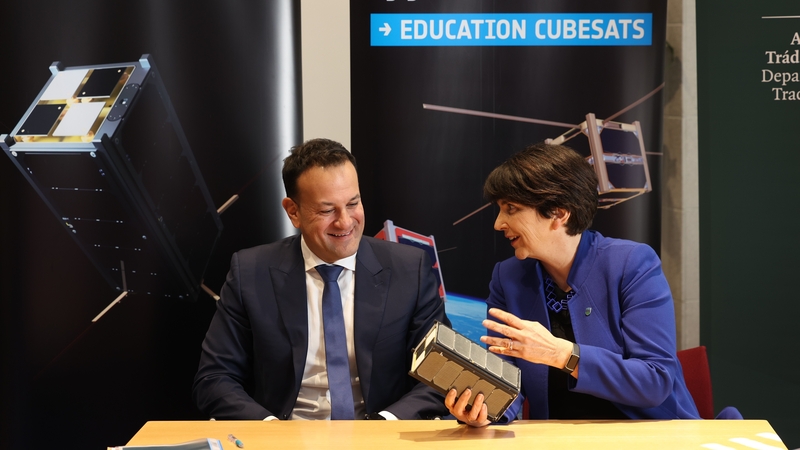

Ireland's first satellite, EIRSAT-1, is scheduled to be launched into space from the European Space Agency centre in French Guiana between late January and late February on a four-year mission.
Tánaiste Leo Varadkar said the initiative is a "big moment" for the Irish space sector, as well as potentially a "huge spin-off" for Irish businesses and universities.
He was speaking after signing letters with the European Space Agency, to facilitate the launch a satellite that has been designed and built by academic staff and students at University College Dublin.
Mr Varadkar said that Ireland has increased its financial contribution to the European Space Agency but this has been paid back "in multiples" because Irish aviation and aerospace companies have subsequently secured contracts from the ESA.
Mr Varadkar said EIRSAT-1 has been led by a talented team in UCD which will position Ireland "to benefit from global space industry growth in the coming decades".
UCD's Vice-President for Research, Innovation and Impact Prof Orla Feely said the EIRSAT-1 team have worked "tirelessly for five years" on what she described as "this challenging mission", noting a strong involvement of PhD students in the project.
The Director of UCD C-Space Centre and the EIRSAT-1 project, Prof Lorraine Hanlon said it was "a huge milestone" for the mission that the required agreements to be signed today, following Cabinet approval earlier this month.
The Educational Irish Research Satellite 1, or EIRSAT-1, has received funding from Science Foundation Ireland, Irish Research Council, Enterprise Ireland, UCD, Openet, Department of Enterprise, Trade and Employment, and the European Space Education Resource Office.
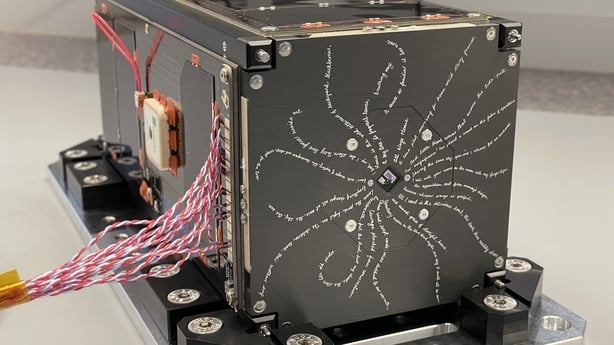
It is hoped the satellite will tell us more about how the universe is formed. It has a control system that will enable it to turn into a magnet and react against the Earth's magnetic field.
A poem is also engraved on the satellite, about home and the universe.