


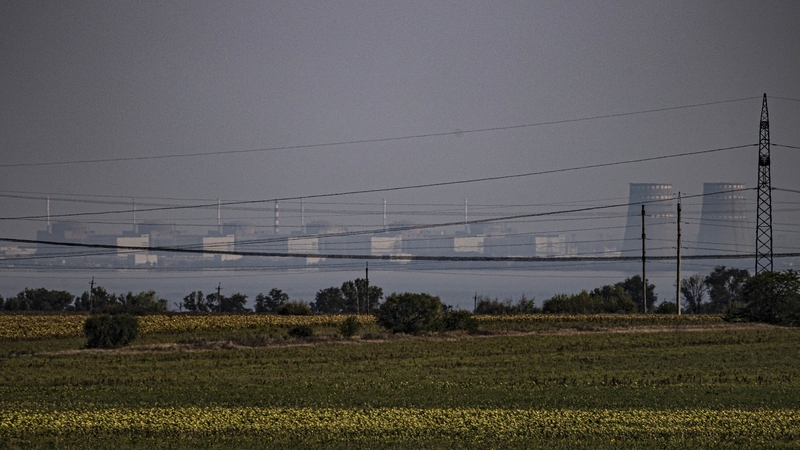
United Nations Secretary-General Antonio Guterres has laid out specific steps for both sides to demilitarise the area around the Russian-held Zaporozhzhia nuclear power plant in southern Ukraine.
The first was for Russian and Ukrainian forces to commit to refraining from military activity in and around the plant, Europe's biggest nuclear power station.
"As a second step, an agreement on a demilitarised perimeter should be secured," Mr Guterres told the UN Security Council.
"Specifically, that would include a commitment by Russian forces to withdraw all military personnel and equipment from that perimeter and a commitment by Ukrainian forces not to move into it."
Ukraine's nuclear operator said it would support the deployment of UN peacekeepers at the plant.
"One of the ways to create a security zone at the (plant) could be to set up a peacekeeping contingent there and withdraw Russian troops" Energoatom chief Petro Kotyn told Ukrainian TV.
Ukraine is considering whether to shut the plant down, its top nuclear safety expert said.
"The option of switching off the station is being assessed," Oleh Korikov told a news briefing by video link
Situation 'untenable'
The International Atomic Energy Agency (IAEA) released a report yesterday which said that the situation at the nuclear power plant, Europe's largest, was "untenable".
Russia's UN Ambassador Vassily Nebenzia told reporters ahead of the council meeting, "if we demilitarise then the Ukrainians will immediately step in and ruin the whole thing".
Russian soldiers were defending the station, Ambassador Nebenzia said.
The International Atomic Energy Agency (IAEA) yesterday called for "a nuclear safety and security protection zone".
IAEA inspectors led by the agency's chief, Rafael Grossi, braved shelling to cross the front line and reach the power station last week.
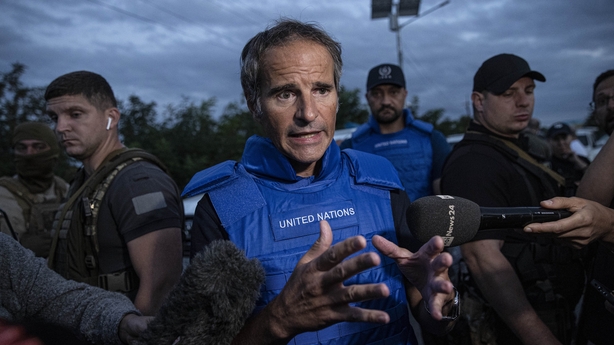
Two experts from the UN nuclear watchdog have stayed on to maintain a long-term presence.
A long-awaited IAEA report listed areas of the plant that had been damaged, including a building housing nuclear fuel, a facility for storing radioactive waste, and a building housing an alarm system.
It said the power station had been cut off several times from offsite power supplies critical to its safe operation.
The report avoided blaming either side for the damage.
The plant was seized by Russian forces shortly after their 24 February invasion of Ukraine, but is still run by Ukrainian technicians.
It sits on a Russian-held bank of a huge reservoir, opposite Ukrainian positions across the water.
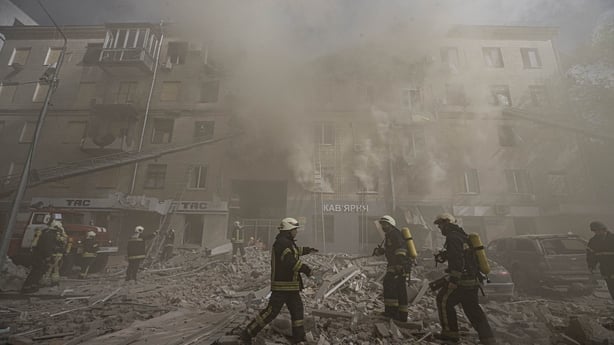
Ukrainian 'counter-attack under way'
The European Commission today proposed €)five billion in financial aid to Ukraine, in the latest instalment of a promised nine-billion-euro rescue package agreed by EU leaders in May.
"The situation in Ukraine requires our full support," the commission's president, Ursula von der Leyen, said in a tweet.
The announcement came as a senior pro-Moscow separatist official said Ukrainian forces attacked the Russian-held eastern town of Balakliia in the Kharkiv region, as Ukrainian officials remained guarded about how a counter offensive was faring.
Luhansk region Governor Serhiy Gaidai told Ukrainian television, without giving locations, that a "counter-attack is under way and ... our forces are enjoying some success. Let's leave it at that".
A presidential adviser had earlier tweeted that there would be "great news" coming from the president on the operation in the northeastern Kharkiv region.
In his address yesterday evening, however, President Volodymyr Zelensky made scant mention of operations in the Kharkiv region, but he did say five Russian cruise missiles were shot down yesterday, most of them in the south.
Reuters was unable to independently verify the Ukrainian officials' comments and there was no immediate response from Russia.
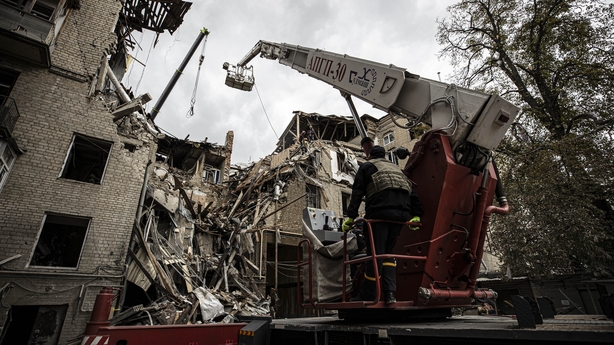
But an official with the pro-Moscow breakaway Donetsk People's Republic yesterday gave an unusually frank account of the fighting at Balakliia, an eastern town of 27,000 people that lies between Kharkiv and Russian-held Izyum, a city with a major railway hub used by Moscow to supply its forces.
"Today, the Ukrainian armed forces, after prolonged artillery preparation ... began an attack on Balakliia ... "Daniil Bezsonov said on Telegram, adding that if the town were lost, Russian forces in Izyum would become vulnerable on their northwest flank.
"The Ukrainian armed forces concentrated mass fire on the mobile groups of the Donetsk People's Republic, which had taken up defensive positions in nearby forests.
"At this time, Balakliia is in operative encirclement and within the firing range of Ukrainian artillery. All approaches are cut off by fire."
Several posts on social media from military bloggers and witnesses also reported fighting around Balakliia.
Vadym Krokhmal, member of the town council of Kupyansk, a town east of Kharkiv that has been occupied for the past five months, posted a video online urging residents not to take part in any referendum on joining Russia that occupying forces might stage.
"Very soon, the Ukrainian armed forces will liberate Kupyansk. We know this, we are certain of this," Mr Krokhmal said, advising people to stock up on food and charge power sources.
"All we need is a little patience."
Little information has emerged about progress of the main Ukrainian offensive in the southern Kherson region, with Kyiv barring journalists from the front line and releasing only limited reports to preserve the element of surprise.
Russia says it has repelled the Kherson assault, but Ukraine has reported steady success.
"We are pursuing positional battles. And there are already areas that we have liberated," Natalya Humenyuk, a spokesperson for the south district of the Ukrainian armed forces, told national television according to media reports.
Western military experts say Ukraine's aim in the south appears to be to trap thousands of Russian troops on the west bank of the wide Dnipro River and cut them off by destroying their rear supply lines.
The announcement of a simultaneous Ukrainian advance near Kharkiv was an indication that Russian troops were having difficulty reinforcing along the front, Mark Hertling, a retired former US commander of ground forces in Europe, said in a tweet.
