


Russia has called on Ukrainian forces to lay down their arms in the eastern port city of Mariupol where Moscow said a "terrible humanitarian catastrophe" was unfolding.
"Lay down your arms," Colonel-General Mikhail Mizintsev, the director of the Russian National Center for Defence Management, said in a briefing distributed by the defence ministry.
"A terrible humanitarian catastrophe has developed," Mr Mizintsev said.
"All who lay down their arms are guaranteed safe passage out of Mariupol."
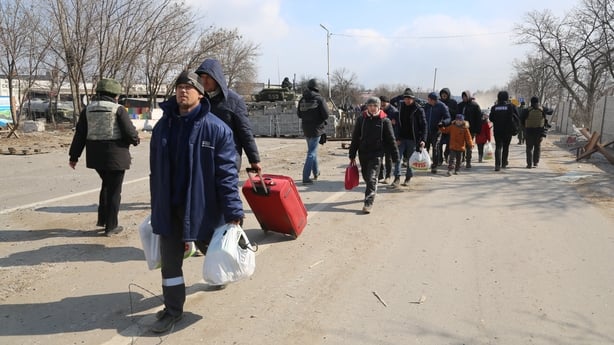
Mariupol has suffered some of the heaviest bombardment since Russia invaded Ukraine on 24 February. Many of its 400,000 residents remain trapped in the city with little if any food, water and power.
Mr Mizintsev said humanitarian corridors for civilians would be opened eastwards and westwards out of Mariupol at 10am Moscow time.
Ukraine has until 5am Moscow time to respond to the offer on humanitarian corridors and laying down arms, he said.
The UN refugee agency said 10 million people had now been displaced across Ukraine, including some 3.4 million who have fled to neighbouring countries such as Poland. Officials in the region said they were reaching capacity to comfortably house refugees.
Read all the latest news from Ukraine here
Capturing Mariupol would help Russian forces secure a land corridor to the Crimea peninsula that Moscow annexed from Ukraine in 2014. Fighting continued inside the city today, regional governor Pavlo Kyrylenko said, without elaborating.
The city council said on its Telegram channel last night that several thousand residents had been "deported" to Russia over the past week. Russian news agencies said buses had carried hundreds of people Moscow calls refugees from Mariupol to Russia in recent days.
President Vladimir Putin says Russia's "special operation" is aimed at disarming Ukraine and rooting out people he terms dangerous nationalists. Western nations call it an aggressive war of choice and have imposed punishing sanctions aimed at crippling Russia's economy.
Ukraine and its Western backers say Russian ground forces have made few advances in the last week, concentrating their efforts instead on artillery and missile strikes.
Ukrainian presidential adviser Oleksiy Arestovych said today that there had been a relative lull over the past day, with "practically no rocket strikes on (Ukrainian) cities". He added that front lines were "practically frozen".
Mariupol's city council said Russian forces had bombed an art school yesterday, in which 400 residents were sheltering, but the number of casualties was not yet known.
Reuters could not independently verify the claims. Russia denies targeting civilians.
Mr Zelensky said the siege of Mariupol was a war crime.

"To do this to a peaceful city... is a terror that will be remembered for centuries to come," he said in a broadcast late on Saturday.
Still, he said, peace talks with Russia were needed although they were "not easy and pleasant".
'What are they doing here?'
The UN human rights office said at least 902 civilians had been killed in the war as of midnight Saturday, though it says the real toll is probably much higher. Ukrainian prosecutors said 112 children had been killed.
"I want the war to be over, I want them (Russian forces) to leave Ukraine in peace," said Margarita , 87, who survived Nazi Germany's siege of Leningrad in World War Two and has lived in eastern Ukraine, for the past 60 years.
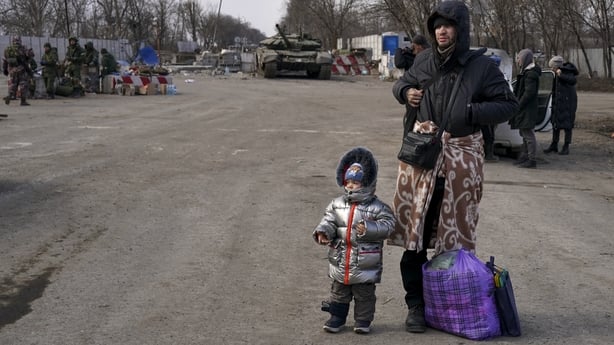
"Ukraine is an independent country. What are they doing here?"
Russia's defence ministry said cruise missiles were launched from ships in the Black Sea and Caspian Sea, as well as hypersonic missiles from Crimean airspace.
The hypersonic missiles travel faster than five times the speed of sound and their speed, manoeuvrability and altitude make them difficult to track and intercept.

They were deployed yesterday by Russia for the first time in Ukraine, Russia's Interfax news agency reported, in a strike which Moscow said destroyed a large underground depot for missiles and aircraft ammunition.
A spokesperson for the Ukrainian Air Force Command confirmed the attack in the western Ivano-Frankivsk region, but said the Ukrainian side had no information on the type of missiles used.
In the southern city of Kherson, a video clip obtained by Reuters showed dozens of protesters, some wrapped in Ukraine's blue and yellow national flag, chanting "Go home" in Russian to two military vehicles bearing Russian markings. The vehicles then turned and left the area.
Diplomacy
Mr Zelensky, who has made frequent appeals for more help from abroad, is due to address the Israeli parliament via video link today. Israeli Prime Minister Naftali Bennett has held numerous calls with both Putin and Mr Zelenskiy in recent weeks to try to end the conflict.
Foreign Minister Mevlut Cavusoglu of Turkey, another country seeking to mediate, said Russia and Ukraine were getting closer to agreement on "critical" issues.
Kyiv and Moscow reported some progress in talks last week toward a political formula that would guarantee Ukraine's security, while keeping it outside NATO - a key Russian demand - though each side accused the other of dragging things out.
Russian forces have also taken heavy losses in the war, and long columns of troops that bore down on the capital Kyiv have been halted in the suburbs. Ukraine's military said today that Moscow's combat losses included 14,700 personnel and 476 tanks.
Russia last acknowledged on 2 March that nearly 500 of its soldiers had been killed. Reuters has not been able to independently verify the death count.
Mr Zelensky's office said today that Ukraine sees a high risk of an attack launched from Belarus on the western Volyn region, which lies to the north of the city of Lviv. It was not immediately clear whether Ukraine saw such an attack coming from Russian or from Belarusian forces.
While Belarus is a close ally of Putin's and has served as a staging post for Russian forces, it has so far not publicly committed troops to supporting Russia.
