

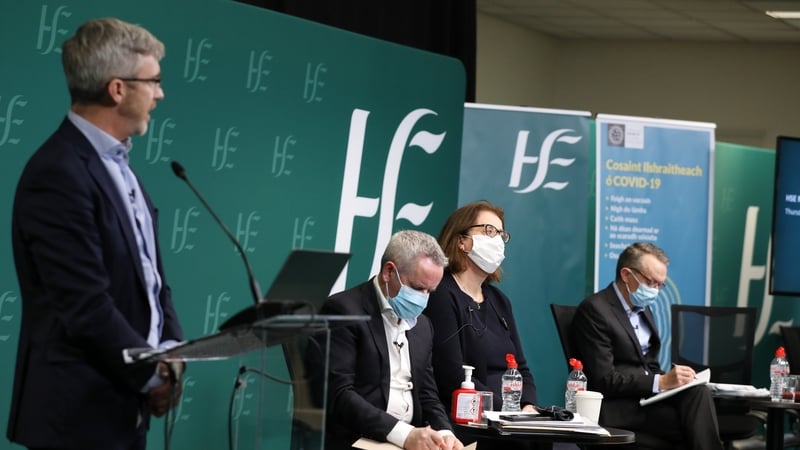
From soaring demand for antigen tests, to evidence supporting the idea that the Omicron variant of Covid-19 is associated with less severe illness than earlier variants, here are seven things we learned from the Health Service Excecutive coronavirus briefing.
Antigen tests in high demand
HSE CEO @paulreiddublin says there is a significant demand for antigen tests. | More: https://t.co/kLrhY9reqK pic.twitter.com/BWrFn9N6Kg
— RTÉ News (@rtenews) January 6, 2022
HSE Chief Executive Paul Reid said that there has been significant demand for antigen tests.
He said 299,000 kits have been distributed or booked for asymptomatic close contacts of confirmed cases of Covid-19.
Following a change in policy whereby people aged 4-39 who have symptoms of Covid-19 are advised to take an antigen test before requesting a PCR, Mr Reid said that almost 100,000 kits have been distributed in such cases.
He said it is not an infinite supply, and urged people to only request the tests when they meet the criteria.
Thousands of health workers absent due to pandemic
HSE CEO @paulreiddublin says the manual counted number of staff out with Covid-19 is 8,500. But adds, that number could be even double. | More: https://t.co/kLrhY9reqK pic.twitter.com/Zz5GL9kAqN
— RTÉ News (@rtenews) January 6, 2022
Mr Reid said that thousands of healthcare workers are currently out of work, either because they have confirmed Covid-19 infections or because they are close contacts of confirmed cases.
Manual counts of absences show that 8,500 HSE staff members are currently absent due to Covid-19 reasons.
However, he said the real number is likely to be even higher, and could be as much as double.
With 3,000 nurses and thousands of other frontline workers affected, that is having "a real, frontline impact" on health services, Mr Reid said.
Age profile of ICU patients shifts slightly, unvaccinated disproportionately hit
HSE Chief Clinical Officer Dr Colm Henry says ICUs are seeing slightly younger ICU patients than before, while 51% of admissions to ICU for #Covid19 are unvaccinated people, despite only about 5% of the eligible population not being vaccinated | https://t.co/qrIlbWm31h pic.twitter.com/ttkJY39Yfl
— RTÉ News (@rtenews) January 6, 2022
HSE Chief Clinical Officer Dr Colm Henry said there has been a "shift to the left" in terms of the age profile of Covid-19 patients in intensive care units.
He said the over 50s had accounted for 68% of ICU patients, but that has fallen to 56% in January.
Dr Henry said that unvaccinated people continue to account for the highest proportion of people in ICU, even though they now comprise a very small proportion of the population eligible for vaccination.
He said the approximately 5% of people who are not vaccinated against Covid-19 make up 51% of the people admitted to ICU with the virus.
Respiratory illnesses accounting for greater share of emergencies
Consultant Respiratory Physician at Beaumont Hospital Ross Morgan said about one in five hospitalisations to Emergency Departments before the pandemic related to acute respiratory problems. He said now, about 30 to 40% of patients coming through now have a respiratory complaint. pic.twitter.com/oh5lcVuKIe
— RTÉ News (@rtenews) January 6, 2022
Consultant Respiratory Physician at Beaumont Hospital Ross Morgan said that only about 20% of hospital admissions through emergency departments before the pandemic were due to respiratory issues.
However, the figure now is 30-40%. He said that there was already a "huge burden" of respiratory disease, and Covid has exacerbated that.
WHO data suggests Omicron milder
HSE Chief Clinical Officer Dr Colm Henry says data from the @WHO suggests the Omicron variant of #Covid19 has a strong growth advantage over Delta, while there is increasing evidence of less clinical severity. There is also evidence of immune evasion | https://t.co/qrIlbWm31h pic.twitter.com/ewFKjefvj0
— RTÉ News (@rtenews) January 6, 2022
Giving an update on WHO evidence on the Omicron variant, Dr Henry said there is "substantial evidence" that it has a growth advantage over Delta, with a doubling time of two-three days.
He said there is increasing data that there is less clinical severity associated with Omicron, and less risk of hospitalisation.
However, he cautioned that it is too early to say what the effect will be on the people who do become ill enough to require hospitalisation.
Dr Henry said there is evidence of immune evasion, both for those who are vaccinated and those who have had previous infection.
He said that there is some evidence that the variant affects the upper airways rather than the lungs, which may account for decreased virulence.
Five-day average close to 20k cases
Dr Colm Henry says the five-day moving average is 19,259 and says the number of people in hospital is 941. | More: https://t.co/kLrhY9IPii pic.twitter.com/EgkqjBqoFN
— RTÉ News (@rtenews) January 6, 2022
Dr Henry said that case numbers are far exceeding those seen last January, with the current five-day moving average of over 19,000 cases more than double the rate recorded last year.
However, he noted that despite the significantly higher case numbers at present, the number of people in hospital is much lower than at the same time last year, while the number of people being treated in intensive care units has remained relatively stable. There are 94 people in ICUs at the moment; less than half the peak number seen last January.
He said this could be attributed to the protection vaccination has afforded to individuals, but also perhaps to some features of the Omicron variant of Covid-19, which now accounts for nearly all of the infections in the country.
Fewer beds available in many hospitals
Chief Operations Officer with the HSE Anne O'Connor said that the weekly trolley count has "gone up significantly" on last week. She added that there were 249 patients on trolleys at 8am this morning. | More: https://t.co/kLrhY9reqK pic.twitter.com/dH4E1UoTne
— RTÉ News (@rtenews) January 6, 2022
HSE Chief Operations Officer Anne O'Connor warned that hospitals are coming under pressure, with increasing levels of unscheduled care leading to greater numbers of patients on trolleys.
She said that there is congestion at a number of sites, including Level 3 sites such as Letterkenny, Mullingar, and Portlaoise.
