


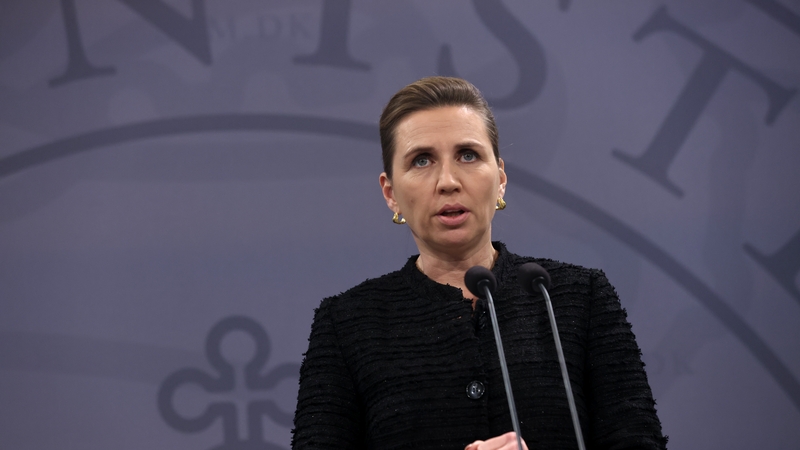
Denmark is to close cinemas, theatres and concert halls and restrict restaurant opening hours over a record number of daily Covid-19 cases, accelerated by the Omicron variant.
The government also plans to close other gathering places such as amusement parks and museums.
"Theatres, cinemas and concert halls, they will have to close," Prime Minister Mette Frederiksen told a news conference.
"We need to limit our activity. We all need to limit our social contacts," she added.
The measures will come into force on Sunday morning for four weeks, the government said.
This is a sharp turnaround for the Nordic country, which had lifted all restrictions on 10 September, before reintroducing a coronapass at the beginning of November and then announcing a first round of restrictions last week.
Dealing with new record numbers on a daily basis, the government has accelerated the roll-out of booster doses of Covid-19 vaccines, authorised an anti-Covid pill treatment by US drugmaker Merck for serious cases and started vaccinations of children aged five to 11.
The Scandinavian country recorded a new all-time high of more than 11,000 cases in the past 24 hours, Ms Frederiksen said.
Denmark, which sequences more samples than many other countries, is among those countries with the highest numbers of confirmed Omicron cases.
More than 2,500 cases of the reportedly more transmissible variant have been recorded in the last 24 hours.
Restaurants and nightclubs will need to close at 11pm, instead of the current limit of midnight, and alcohol sales will be banned after 10pm.
The government said in the afternoon that parliament had approved the measures.
Unlike during earlier virus waves, Ms Frederiksen said the government still planned to re-open schools after the holidays, even though the Christmas break had already been extended to counter the surge.
"Our aim is still to keep society as open as possible," she said, adding that more restrictive measures introduced in the spring of 2020 could be avoided "because we have vaccines".
Denmark has reported a total of 600,468 cases of Covid-19 since the start of the pandemic and 3,054 associated deaths.
Around 500 people are currently hospitalised, including a few dozen in intensive care. Hospitals expect the number of hospitalisations to hit 1,000 in the country of 5.8 million people.
Read more: Latest coronavirus stories
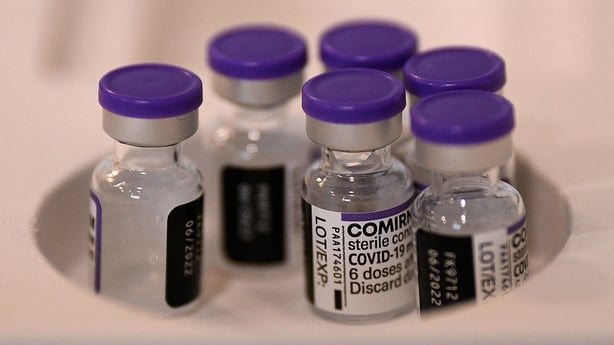
EU to place order for Omicron-adapted Pfizer Covid jabs
European Union governments have agreed to exercise an option to buy more than 180 million doses of a version of the Covid-19 vaccine adapted for the Omicron variant developed by BioNTech and Pfizer, the head of the European Commission has said.
Pfizer and BioNTech began development of a prototype Omicron-specific vaccine on 25 November, and said they could have it ready in March.
"The Member States have agreed to trigger a first tranche of over 180 million extra doses of adapted vaccines, in our third contract with BioNTech-Pfizer," Ursula von der Leyen told a news conference at the end of a regular summit with EU leaders.
A spokesperson for the commission said deliveries would start in the second quarter of this year, should the adapted vaccine be available and authorised by then.
"This order covers the adapted vaccines," the spokesperson added.
The EU's latest contract with Pfizer and BioNTech allows EU states to buy up to 1.8 billion doses through 2023, of which half have already been ordered and the other half are optional.
Pfizer said that talks with the EU for their possible supply of optional doses had so far not concerned adapted versions of the vaccine.
"At this time, discussions with the EC about the potential for additional supply pursuant to their option rights under our agreement are not specific to an adapted vaccine," Pfizer said in a statement.
"While we believe we can deliver an adapted vaccine in March 2022, we do not yet know whether this will be needed and availability will require authorisation by regulatory authorities," Pfizer said.
The European Medicines Agency (EMA) has so far said that there is no conclusive evidence an adapted vaccine is needed against Omicron.
EU leaders say jabs, boosters 'vital' against Omicron
EU leaders have said that vaccinations and booster shots will be vital to counter the Omicron coronavirus variant, as countries step up restrictions to slow its startling spread.
The EU summit they were participating in also emphasised the need for "coordinated efforts" based on science, amid go-it-alone measures applied notably by Italy.
The joint conclusion, swiftly adopted at the beginning of the one-day gathering, underlined the urgency Omicron has injected into European policy-making just three weeks after South African researchers detected the strain.
"It is spreading at the ferocious pace and potentially has a risk of escaping our vaccines, at least partially," said Ms von der Leyen.
Alarm over the Omicron variant galvanised the meeting in Brussels, to which all participants only had access if they could show a negative PCR test, regardless of their vaccination status.
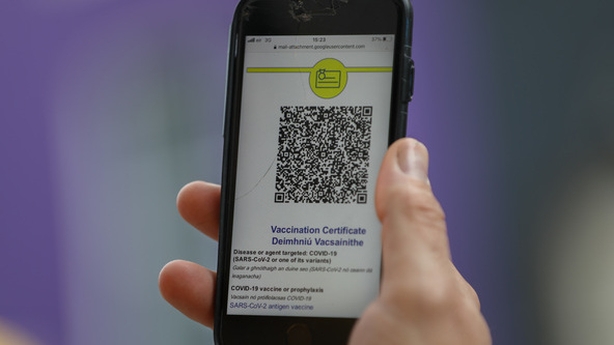
if a booster has not been added
"Rolling out vaccination to all and deploying booster doses are crucial and urgent," the leaders said in their joint conclusion.
But they also had a warning from the European Centre for Disease Prevention and Control ringing in their ears that Omicron's high infectivity - doubling cases every two days - meant it was too late to overcome the "vaccination gap" among EU countries.
Several countries have already announced they will impose pre-arrival Covid tests on all EU arrivals.
That undermined an EU Covid certificate that had previously exempted vaccinated travellers from such tests.
The European Commission said that Italy had not given the requisite 48-hour notification before bringing in its added restriction.
One mooted plan is to make the Covid certificate expire after nine months if a booster has not been added.
"This could hopefully ... help to move back to a more coordinated situation and policy," said Dutch Prime Minister Mark Rutte.
"But," he added, "at the core is an understanding that member states have to take measures when their national health issues demand them."
French President Emmanuel Macron said that extra tests at intra-European borders would have a "very reduced effectiveness" since most travel was by people exempted from the rules anyway.

would have a "very reduced effectiveness"
"From the moment when such and such a variant is present in a country of the EU, it spreads to the others," he said.
This however did not stop France from announcing a ban on tourist travel from Britain, and tighter testing requirements for French and EU citizens or those with compelling reasons, who are still allowed in.
Britain, a former EU member, is the epicentre of Omicron infections in Europe.
Greek Prime Minister Kyriakos Mitsotakis said he foresees the additional testing obligation being only "for the Christmas period, in order for us to gain additional time to boost as many people as possible".
Mr Mitsotakis added: "It's a battle against time."
The variant is also spreading fast in Norway and in the EU, notably in Denmark, France, Germany and Belgium.
Ms von der Leyen said projections suggested the mutated Covid strain could be dominant in the EU as early as next month.
The timing is perilous, promising a tough winter in Omicron's shadow at a time people usually get together with family, workmates and friends to celebrate Christmas and the New Year. For most, those festivities were absent or minimised last year because of Covid restrictions.
Although many EU countries are in the global vanguard in terms of vaccination rates, the rollout is patchy across the 27-nation bloc.
Vaccination rates below 60% in nine EU countries
Nine EU countries have vaccination rates below 60%, with eastern member states' populations especially hesitant to get jabs.
That data spurred calls for more inoculations, but also for greater coordination, for fear that European Union unity could fracture as boosters take on more importance to improve antibody defences against Omicron.
The EU leaders said they wanted to ensure that "any restrictions are based on objective criteria and do not undermine the functioning of the Single Market or disproportionately hamper free movement between Member States or travel into the EU".
