


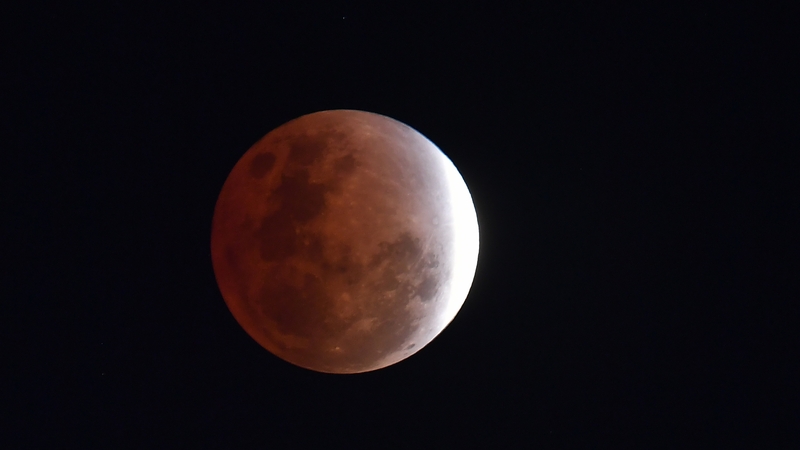
The longest partial lunar eclipse in nearly 600 years, bathing the Moon in red, was visible for a big slice of humanity today.
The celestial show saw the lunar disc almost completely cast in shadow as it moved behind the Earth, reddening 99% of its face.
The partial eclipse of the Moon was visible over Ireland from 7.30am this morning.
Frances McCarthy, the outreach director at Blackrock Observatory in Cork, said that the partial eclipse would happen in the west-northwest skies and would be visible until moonset from around 8am.
Ms McCathy said the setting Moon would be covered in coloured light and she expected to see a deep orange Moon as the partial eclipse occurs.
The spectacle was visible for all of North America and parts of South America, and later in Polynesia, Australia and northeast Asia.
By 7.50am Irish time, sky-watchers with a cloud-free view in those regions saw the Moon half covered by the Earth's penumbra - the outer shadow.
Space scientists said yesterday that by 8.45am the Moon would appear red, with the most vivid colouring visible at peak eclipse 18 minutes later.
The dramatic red is caused by a phenomenon known as 'Rayleigh scattering', where the shorter blue lightwaves from the Sun are dispersed by particles in the Earth's atmosphere.
Red light waves, which are longer, pass easily through these particles.
"The more dust or clouds in Earth's atmosphere during the eclipse, the redder the Moon will appear," a NASA website explained.
"It's as if all the world's sunrises and sunsets are projected onto the Moon."
From the moment the eclipse began - when the Moon entered the Earth's shadow - to when it ends will take more than three hours and 28 minutes.
That is the longest partial eclipse since 1440 - around the time Johannes Gutenberg invented his printing press - and will not be beaten until the far-off future of 2669.
But Moonwatchers will not have to wait that long for another show - there will be a longer total lunar eclipse on 8 November next year, NASA said.
Even better news for anyone wanting to watch was that no special equipment is necessary, unlike for solar eclipses.
Binoculars, telescopes or the naked eye gave a decent view of the spectacle - as long as there was good weather here on Earth.
After it passed into the umbra - the full shadow - the whole process goes into reverse as the Moon slithers out of the dark and carries on its endless journey around our planet.
