

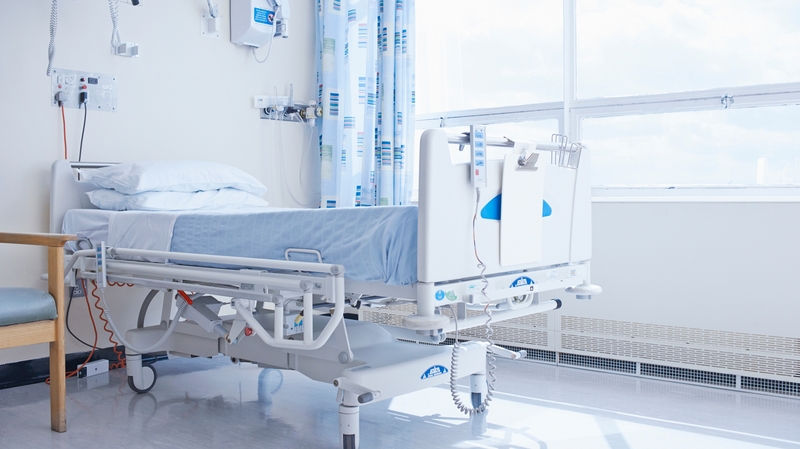
Health Service Executive CEO Paul Reid has said almost a third of ICU beds are currently taken up with Covid-19 positive patients.
Speaking at a HSE Covid briefing, he said there are 90 people in ICU and 458 in hospital with the virus.
Mr Reid also said there is a high level of sickness with the patients who are being treated as 250 patients are receiving advanced respiratory support.
The daily increase in levels of Covid-19 is causing significant and unrelenting pressure on the health service, he said.
He said it was leading to disproportionate demands across the health service from GPs, to hospitals, to public health, with huge pressure on staff.
Mr Reid said 3,500 staff are out of work because of Covid-19.
He said if the numbers continue as they are, the tide needs to be turned but he said he nor the HSE were calling for a need for further restrictions.
They continue to see more and more people registering for vaccines, he said, on average 1,800 people a day coming forward to register.
Paul Reid called on businesses and enterprise to assess what they are doing on some of the basics and check that they are providing safety and security for staff, customers, clients.
This included hand-sanitising and ensuring queuing is done correctly.
He welcomed the use of third vaccines and boosters, which give health care workers extra protection and confidence.
"It is early to say but we are seeing positive trends from those early vulnerable groups who have been vaccinated".
Over the last few days, he said, they are beginning to see a stabilisation in hospital numbers. While they can never be certain, he said he is hopeful this is the start of a trend.
Mr Reid said the HSE is keeping an eye on NPHET projections which showed one scenario where there could be 1,000 people in hospital and 150 to200 in ICU.
There is a possibility that could still happen, he said but he believes measures such as mask wearing could turn the tide.
When asked if the easing of restrictions in maternity hospitals since Monday is being monitored, Paul Reid said site visits are being made.
We need your consent to load this rte-player contentWe use rte-player to manage extra content that can set cookies on your device and collect data about your activity. Please review their details and accept them to load the content.Manage Preferences
Over 20% increase in ED figures since last year
The Chief Operations Officer of the HSE said emergency department attendance figures are up 21% since last year and a lot of sites are very busy.
Anne O'Connor said admissions of people over the age of 75 are also up from this time last year.
She said there were 292 patients on trolleys this morning, but that figure is 30% lower than 2019.
Ms O'Connor said University Hospital Galway has very significant levels of congestion with people presenting to hospital.
She also said the emergency department at University Hospital Limerick is very busy; along with Cork, Drogheda, Waterford and the Mater Hospital in Dublin.
In relation to Covid outbreaks, Ms O'Connor said there are 17 outbreaks in long-term residential care settings and ten in hospitals.
In relation to the cancellation of elective surgeries, Ms O'Connor said there is not a specific number on it but around 21 hospitals have cancelled elective surgeries and they expect to see more cancellations.
'Unvaccinated people cannot rely on the vaccinated population'
The HSE Chief Clinical Officer said this surge is a different shape to the previous one and it has a long slower upslope.
Colm Henry said this is because of the vaccination programme and the protection it gives us, but he said the protection is not limitless.
He said the more cases in the community the more chances there are for someone who is vulnerable to get sick.
Dr Henry said the 98% of the 137 patients who were fully vaccinated in ICU since 1 April had underlying conditions which highlights importance of the booster campaign.
He said the vaccination programme is very effective but is less effective at reducing transmission and that in terms of household contacts, there is still a one in four chance of becoming Covid-positive from such cases.
He also said that unvaccinated people cannot rely on the vaccinated population.
Colm Henry was asked what the conversion rate from case numbers to hospitalisation is.
He said in the last surge there was 30-40 hospitalisations to every 1,000 cases but this surge is seeing half of that.
He said it depends on the age profile and they are primarily concerned with people with underlying conditions and that older people are more likely to need hospitalisations.
'Real improvement in pregnant women getting vaccinated'
The HSE's National Director for the Covid-19 Vaccination programme has said that in the last week, 132,000 community swabs were taken; a 20% increase in referrals.
Damien McCallion said the system is under some pressure but it is coping and 1,000 antigen tests a day have been carried out.
Mr McCallion said the vaccination programme is continuing to run campaigns to target those who are unvaccinated and up to 1,800 a day are coming through the programme.
He also said there has been a real improvement in pregnant women getting vaccinated.
In a study carried out last week through the Women and Infants programme, he said 58% of women confirmed they are fully vaccinated with 75% of their partners also vaccinated.
On the booster programme for over 65s and in long-term residential settings, Mr McCallion said that it has been substantially completed.
He said 475,000 people have been identified in the 60-69 age group and there are 305,000 registered health care workers to be offered another dose, primarily to vaccination centres.
Damien McCallion said pharmacies will come on board to support the programme and he said a facility will be put in place to allow people who have recently become healthcare workers to register.
He said that Ireland has over two million vaccines in terms of stock but the HSE is liaising with the government regarding the COVAX initiative to send more vaccines to countries in need, if needs be.
Mr McCallion said around 1.8 million doses are for the at-risk groups to get their booster vaccines and that deliveries can be reactivated at any point.
He added that the programme is happy there is a "good balance" in place in terms of the government managing the supply.
