

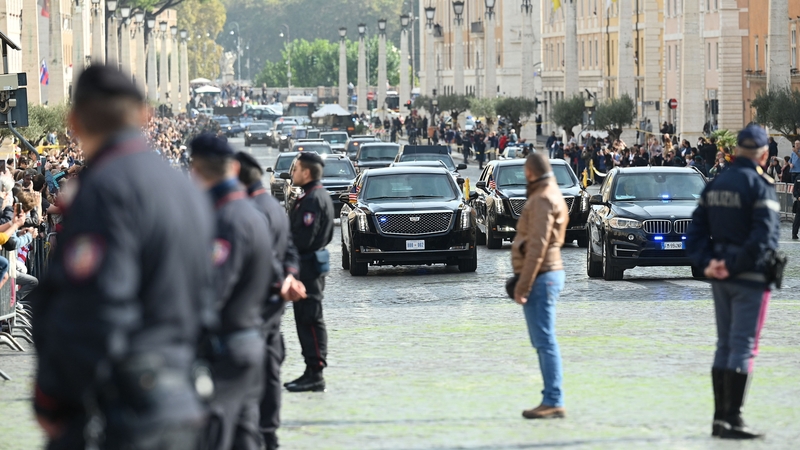
Leaders of the world's 20 biggest economies have said they want 70% of the world to be vaccinated against Covid-19 over the next eight months, as they hold their first face-to-face meeting in two years this weekend in Rome.
Leaders are also expected to make commitments on tackling climate change.
The meeting comes ahead of COP26 - a key climate conference in Scotland - which gets under way in the coming days.
Finance and health ministers from the G20 have said they wanted 70% of the world's population vaccinated against Covid-19 over the next eight months and created a task force to better fight the pandemic.
"To help advance toward the global goals of vaccinating at least 40 percent of the population in all countries by the end of 2021 and 70 percent by mid-2022 ... we will take steps to help boost the supply of vaccines and essential medical products and inputs in developing countries and remove relevant supply and financing constraints," the G20 ministers said in a communique seen by Reuters.
"We establish a G20 Joint Finance-Health Task Force aimed at enhancing dialogue and global cooperation on issues relating to pandemic prevention preparedness and response, promoting the exchange of experiences and best practices, developing coordination arrangements between Finance and Health Ministries, promoting collective action, assessing and addressing health emergencies with cross-border impact, and encouraging effective stewardship of resources," the statement said.
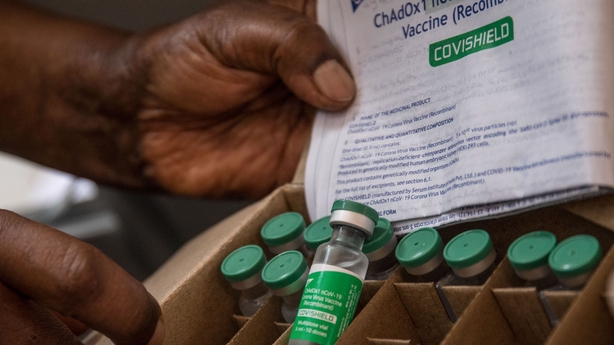
Earlier, a group of former presidents and prime ministers have said the G20 leaders should use their meeting to agree how to transfer surplus Covid-19 vaccines to low-income countries.
In a letter to Italian Prime Minister Mario Draghi, 100 former leaders and government ministers from around the world urged him to use the summit to address what they said was an unfair distribution of vaccines.
The group said the United States, European Union, Britain and Canada would be stockpiling 240 million unused vaccines by the end of the month, which these nations' military could immediately airlift to countries in greater need.
By the end of February a total of 1.1 billion surplus vaccines could be transferred, it said.
"It would be unethical for all these vaccines to be wasted when globally there are 10,000 deaths from Covid-19 every day, many of which could be averted," said the letter, whose signatories include former UN Secretary General Ban Ki-moon and former British prime minister Gordon Brown.
The group said the World Health Organization's aim for 40% of the world's population to be vaccinated by the end of the year could only be met if the G20 made a joint decision to order an emergency transfer of their excess vaccine supplies.
"Vaccine inequality also constitutes a threat to us all," it said.
"We are all not safe until everyone is safe. Without urgent and widespread vaccination, variants will continue to arise in unvaccinated regions, and may well spread from there to challenge the vaccine protection achieved hitherto in more vaccinated countries."
The head the Health Service Executive's Vaccine Programme has said that Ireland recently completed a delivery of 340,000 vaccines, which were at risk of expiring, to Uganda.
Speaking on RTÉ's Morning Ireland, Damien McCallion Ireland has sufficient vaccine stock to support its booster programme and has ceased delivery of all its vaccines.
He said Ireland has committed around 1 million vaccines under the international COVAX programme by year's end.
Where there are vaccines in danger of expiring, he said, bilateral agreements with other countries that need them will be undertaken.
G20 host Italy had hoped the G20 summit would see all leaders meet face-to-face.
However, China's President Xi Jinping will participate via video link, while Russian President Vladimir Putin and Japanese Prime Minister Fumio Kishida will also not attend in person.
Meanwhile, US President Joe Biden has been meeting Pope Francis at the Vatican ahead of the summits.
Leaders expected to make commitments on climate change
In a draft communique seen by Reuters, G20 leaders will commit this weekend to tackling the existential threat of climate change, paving the way for more detailed action at COP26.
The G20, whose countries account for 80% of global carbon emissions, is considered an important stepping stone before COP26 climate summit in Scotland, which begins on Sunday.
Mr Xi is also not expected to attend COP26 in person, which could indicate that the world's biggest CO2 producer has already decided that it has no more concessions to offer at the UN COP26 climate summit after three major pledges since last year, climate watchers said.
The G20 also aims to underline that rich countries should stump up $100 billion per year to help poorer nations adapt to climate change.
This goal was supposed to be achieved by 2020, according to an agreement reached in 2009, but has not been met.
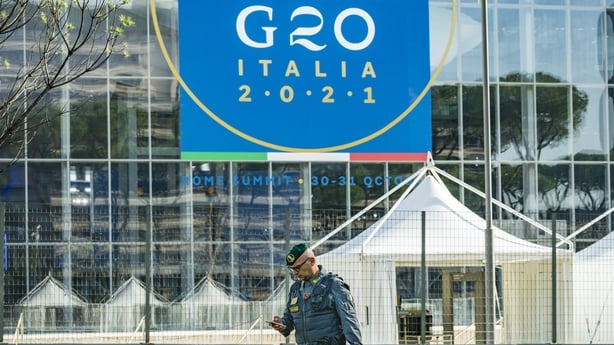
G20 leaders will pledge to take urgent steps to reach the goal of limiting global warming to 1.5C, according to the draft.
They will then head to Glasgow, Scotland for the crucial United Nations gathering of almost 200 countries.
The landmark 2015 Paris agreement committed signatories to keeping global warming to "well below" 2C above pre-industrial levels, and preferably to 1.5C.
Since then, as extreme weather episodes have intensified and carbon levels in the atmosphere have grown, climate scientists have increasingly emphasised the importance of a 1.5C cap to limit the risk of environmental catastrophe.
"Responding to the call of the scientific community, noting the alarming reports of the IPCC Intergovernmental Panel on Climate Change (IPCC) and mindful of our leadership role, we commit to tackle the existential challenge of climate change," the draft, which might still be changed, said.
"We recognize that the impacts of climate change at 1.5C are much lower than at 2C and that immediate action must be taken to keep 1.5C within reach," the G20 said.
"We acknowledge the key relevance of achieving global net zero greenhouse gas emissions or carbon neutrality by 2050," the statement said, referring to a recommendation by UN climate experts who say the mid-century deadline is crucial to meet the 1.5C warming limit.
However, the 2050 date appears in the draft in brackets, indicating it is still subject to negotiation.
Some of the world's biggest polluters say they cannot reach the 2050 target date, with China, by far the largest carbon emitter, aiming for 2060.
The G20 bloc, which includes Brazil, China, India, Germany and the United States, accounts for more than 80% of the world's gross domestic product, 60% of its population and an estimated 80% of global greenhouse gas emissions.
The G20 reaffirmed a commitment to "phase out and rationalise" fossil fuel subsidies by 2025 and to curb coal power, considered a principal culprit of global warming.
The leaders said they will "do their utmost" to avoid building new unabated coal plants, adding the phrase "taking national circumstances into account," which is commonly used to avoid firm commitments.
The leaders said they would end public finance for overseas coal plants by the end of this year and aim for a "largely decarbonised" power system in the 2030s, according to the draft.
They also pledged to cut their collective emissions of methane, a greenhouse gas which is much more potent but less long-lasting than carbon dioxide, "substantially" by 2030. This deadline is also in brackets.
The willingness of developed countries to help finance the ecological transition of poorer ones, known as "climate financing", is likely to be crucial to the success of the G20 and the Glasgow summit.
"We stress the importance of fulfilling the joint commitment of developed countries to mobilise $100 billion annually from public and private sources through to 2025 to address the needs of developing countries, in the context of meaningful mitigation actions and transparency on implementation," the draft said.
Richer countries agreed in 2009 to establish a $100 billion per year fund to help transfer technologies and minimise climate risks in the developing world, but progress has been slow.
Alok Sharma, President of the COP26 conference, said this week he hoped the fund would be made available in 2023, three years later than planned, and many developing nations are reluctant to commit to accelerating their emissions reductions until rich ones meet their pledges.
A Chinese environment official said on Wednesday this was "the biggest obstacle" to progress in the climate talks.
The G20 draft calls in brackets for "additional climate financing", suggesting there is plenty of negotiating still to be done on this issue.
