


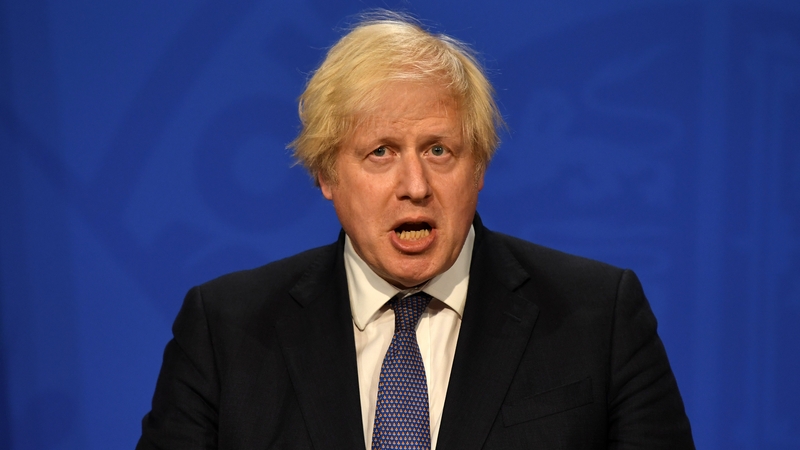
British Prime Minister Boris Johnson has confirmed that most Covid-19 restrictions in England will be lifted next Monday 19 July, but stressed that the "pandemic is not over" yet.
At a Downing Street press conference this evening, Mr Johnson said it would be "absolutely vital" to proceed with caution even as the requirements for mask wearing and social distancing are lifted from next week.
He said that from 19 July, people cannot revert "instantly" to "life as it was before" as Britain faces into a third wave of Covid-19 infections.
"This disease continues to carry risks for you and your family," he said.
"I cannot say this powerfully or emphatically enough, this pandemic is not over. To take these steps we must be cautious and must be vaccinated."
Mr Johnson urged the public to exercise "personal responsibility" when the legal restrictions end.
"On the issue of masks, we're really following the same principle that we're following with all the legislation that we've had in place," he said.
British Prime Minister Boris Johnson has confirmed that most Covid-19 restrictions in England will be lifted on 19 July, but stressed that the "pandemic is not over" yet | https://t.co/JkYQVfLHqU pic.twitter.com/iUteB46bmv
— RTÉ News (@rtenews) July 12, 2021
"We're trying to move towards personal responsibility, people thinking about others as well as about themselves and that applies to the social distancing, that applies to how we think about the vulnerable, how we make sure that we continue to exercise extreme caution as we continue in the fight against a very dangerous disease."
He said he hopes that the easing of measures is "irreversible" and that was why his government is advising a "cautious approach".
Mr Johnson said that it would be recommended for people to still wear face coverings in crowded and enclosed spaces, such as public transport.
He said that the British government will set out guidance for businesses for a gradual return to offices over the summer.
Mr Johnson also said nightclubs and other venues with crowds should use vaccine passports for entry "as a matter of social responsibility".
He said: "As a matter of social responsibility we're urging nightclubs and other venues with large crowds to make use of the NHS Covid Pass which shows proof of vaccination, recent negative test or natural immunity, as a means of entry."
We need your consent to load this rte-player contentWe use rte-player to manage extra content that can set cookies on your device and collect data about your activity. Please review their details and accept them to load the content.Manage Preferences
At the same press conference, England's chief medical officer Professor Chris Whitty said that going slowly through the next step was "essential" to reduce the impact of the "exit wave".
He said there was wide agreement between the scientific community that the four-week delay to the final stage of the road map was important to reduce the number of people admitted to hospital and deaths.
"Secondly, there is extremely wide agreement that whenever we go through the next step, there is going to be what's called an exit wave - there will be a wave associated with that," he said.
"And that the slower we take it, the fewer people will have Covid, the smaller the peak will be, and the smaller the number of people who go into hospital and die.
"So, going very slowly through this step is really essential, and this again is the overwhelming view of the scientific people who have looked at this and of the medical profession.
"This is an overwhelming view. We should go slowly and steadily and cautiously, as the Prime Minister has laid out."
'Go slow'
The peak of the third wave of Covid infection across England is not expected before mid-August and could lead to 1,000 to 2,000 hospital admissions per day, according to analysis published today by scientists advising the British government.
Experts are urging the public to "go slow" once restrictions lift on July 19, to curb infections and cut the number of people who will go on to die from Covid-19.
They recommend that workers do not all head back to the office from mid-July, continue to wear masks in crowded spaces and stay at home when infected or contacted by the NHS app or NHS Test and Trace.
Central estimates from modellers advising the British government show that step 4 of the road map for England and the wave of infection could be associated with 1,000 or more hospital admissions per day at the peak (with an estimate of 1,000 to 2,000 per day).
Deaths are expected to be between 100 and 200 per day at the peak of the wave, though there is a large amount of uncertainty in the modelling.
Most of the modelling presented to the government has a lower expected peak of infection than that seen in January this year.
Scientists argue that if people revert to normal pre-pandemic behaviour all at once on 19 July, then there will be a big wave of infection and larger numbers admitted to hospital.
Instead, if behaviour reverts to normal over several months, the impact will be lower.
In papers newly released by the British government today, a document dated 7 July from the Scientific Advisory Group for Emergencies (Sage) concluded "all modelled scenarios show a period of extremely high prevalence of infection lasting until at least the end of August".
"There is high uncertainty around both the scale of the peak in prevalence and in the number of confirmed cases that this would correspond to."
'Freedom day'
Earlier, British health minister Sajid Javid urged people to show caution when nearly all the remaining Covid-19 restrictions are lifted in England next week, saying an increase in cases underlined that the pandemic was by no means over.
England will be the first nation in Britain to lift the legal requirement to wear masks and for people to socially distance from 19 July, Mr Javid announced.
But what was once billed as "freedom day" is now being treated with greater wariness by the British government after a surge in cases and fears that there could be as many as 100,000 new infections a day over the summer.
Mr Javid announced to parliament that the four conditions to relax strict curbs on behaviour had been met, but also urged people to act responsibly because the link between cases and deaths while "severely weakened" had yet to be fully broken.
"Thanks to the shared sacrifices of the British people and the protective wall of our vaccination programme, we have made huge advances," Mr Javid said.
"We firmly believe that this is the right time to get our nation closer to normal life... It's the start of a new phase of continued caution."
He said people should still wear masks in crowded areas such as public transport, that people should gradually move back to the workplace and the government would encourage businesses holding mass events to use certification as a way to open up.
Britain has implemented one of the world's fastest vaccination programmes, with more than 87% of adults having received at least one dose of a Covid-19 vaccine and 66% having received two.
The government argues that the fact that deaths and hospital admissions remain far lower than before, even though cases have risen sharply, is proof that the vaccines are saving lives and it is safer to open up.
But the surge in infections to rates unseen since the winter has prompted concern, with some epidemiologists saying the Euro 2020 soccer championships might have helped fuel the rise.
A further 34,471 new coronavirus cases were confirmed across the UK today, with six further deaths recorded within 28 days of a positive test.
Additional reporting - Reuters
