


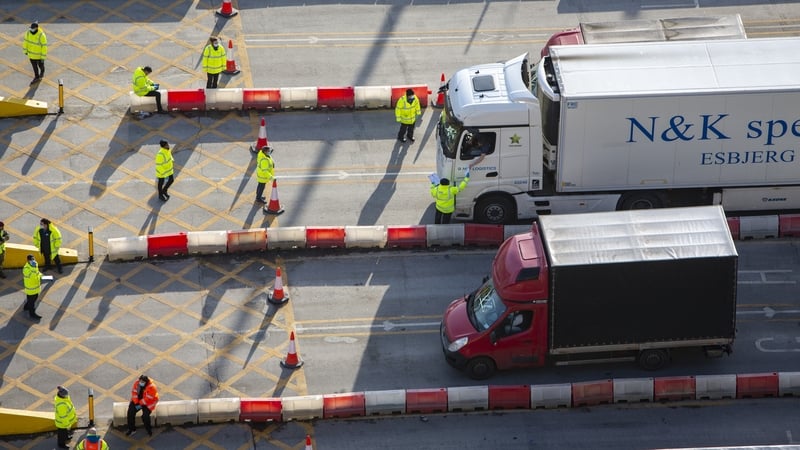
France is to keep in place restrictions on its border with Britain "until further notice", Prime Minister Jean Castex said, after the country confirmed two clusters of the mutant UK coronavirus variant.
France closed its border with Britain on 20 December after the emergence of a new strain of the disease in southeast England, which is thought to be far more contagious
"This will be extended until further notice", Mr Castex said.
Only certain categories of people, including truck drivers, are allowed through the border providing they have can show a negative PCR test during the three preceding days.
The French health ministry also reported that two clusters of the variant had been detected in a care home in the western French region of Brittany, and in Bagneux, a southern suburb of Paris.
"We are clearly expecting to identify others," Health Minister Olivier Veran told a news conference.
In the home, near the city of Rennes, seven residents and two staff were infected "with a variant form of the virus", the ministry said.
Final test results were expected by the start of next week, the ministry said.
In Bagneux, one person who works in two different schools was also found to be infected with the mutant strain.
Japan declares one-month state of emergency for Tokyo
Japan has declared a one-month state of emergency in the capital, Tokyo, and three neighbouring prefectures to stem the spread of Covid-19 infections, as new daily cases surged to a record of more than 7,000.
The government said the emergency would run from 8 January until 7 February in Tokyo and Saitama, Kanagawa and Chiba prefectures, covering about 30% of the country's population.
Restrictions would centre on measures to combat transmission in bars and restaurants, which the government says are main risk areas.
The curbs are less stringent than those imposed nationwide in April under an emergency that ran to late May, as the government seeks to limit damage to the world's third-biggest economy while striving to defeat the virus once and for all as it looks ahead to staging the postponed summer Olympics.
"The situation has become increasingly troubling nationwide and we have a strong sense of crisis," Prime Minister Yoshihide Suga told a news conference.
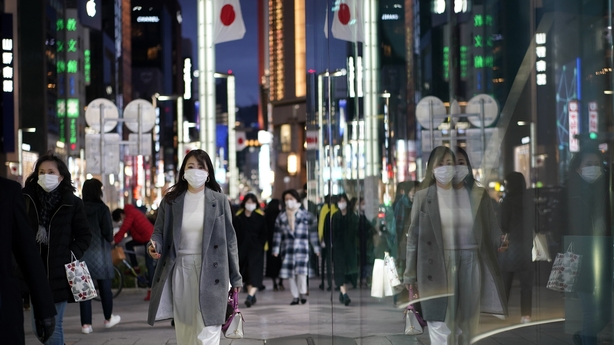
Though still less seriously affected by the pandemic than many countries around the world, Japan has been unable to rein in the virus to the extent some countries in the region have.
Tokyo in particular has been a constant worry with its tally of positive tests jumping to 2,447 today, from a record of 1,591 the previous day.
Authorities aim to start a vaccination campaign by the end of February.
The emergency comes into force tomorrow, with measures including asking restaurants and bars to close by 8pm, and residents to refrain from non-urgent outings.
More people are to work from home, and there will be a limit on crowds at sports and other big events of 5,000 people.
The four prefectures are home to about 150,000 restaurants and bars.
Ahead of the declaration, the Tokyo Metropolitan Government said that exhibitions of the Olympics torch around the capital had been postponed.
Mr Suga has said shorter operating hours for bars and restaurants had helped bring cases down in regions such as Osaka and Hokkaido.
But in a worrying sign, Osaka yesterday reported a record 560 new cases while Hokkaido saw cases surpass 100 for the first time in a week.
Osaka Governor Hirofumi Hashimoto has said he may request a state of emergency for his prefecture as well, given the surge, media reported.
Medical experts have said they fear the government's plans might not be enough.
"We may need to think about a state of emergency nationwide," Toshio Nakagawa, president of the Japan Medical Association, said.
According to simulations by Kyoto University scientist Hiroshi Nishiura, infections in Tokyo could reach 3,500 a day by February and hit 7,000 by March without new measures.
Emergency measures could take at least two months to bring infections to manageable levels, he said.
Brazilian trial shows Chinese vaccine is 78% effective
A Covid-19 vaccine developed by China's Sinovac Biotech was 78% effective in a late-stage Brazilian trial, a person familiar with the study has said, moving the shot closer to regulatory approval in South America's biggest country.
The results, closely watched by developing countries counting on the vaccine to begin mass inoculations, come after Turkish researchers said in December that the vaccine showed 91.25% efficacy based on interim data.
Brazil and Indonesia, which have the most Covid-19 cases in Latin America and southeast Asia respectively, are preparing to roll out the vaccine, called CoronaVac, this month.
Although CoronaVac's efficacy trails the more than 90% success rate of vaccines from Moderna or Pfizer and its partner BioNTech, it is easier to transport and can be stored at normal refrigerator temperatures.
Turkey, Chile, Singapore, Ukraine and Thailand have also struck supply deals with Sinovac.
The company's Brazilian partner, biomedical center Butantan, presented the efficacy data to federal health regulator Anvisa in a meeting seeking approval for emergency use of the vaccine, according to the source who spoke anonymously because the results are not yet public.
The findings, first reported by newspaper Folha de S.Paulo ,are based on a study led by Butantan involving about 13,000 volunteers, with half receiving a placebo and half taking the two-dose vaccine.
China has at least five vaccines, developed by Sinovac, Sinopharm, CanSino Biologics and the Chinese Academy of Sciences, in late-stage trials, underscoring its efforts to develop a homegrown vaccine to challenge Western rivals.
