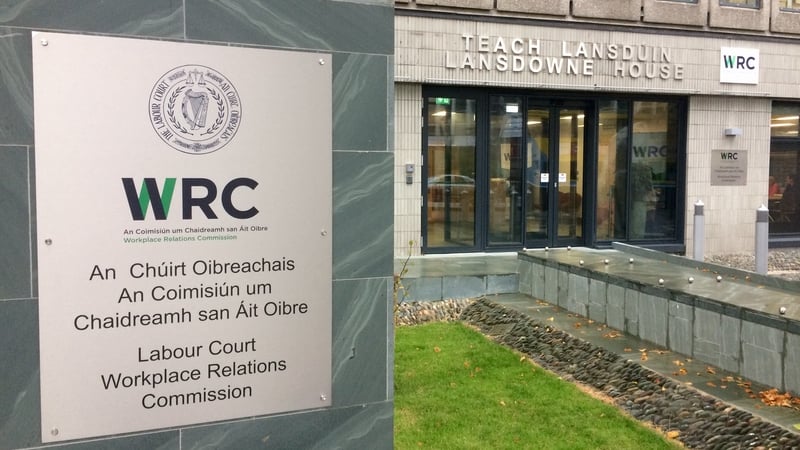

An employment tribunal has awarded €35,000 to a university lecturer after it found the college discriminated against her on the grounds of age.
In a ruling published today, the Workplace Relations Commission said it made the finding because the university had failed to prove that age had had nothing to do with the woman's failure to be promoted.
The tribunal heard that the woman had begun working at the college in 2003, after the completion of her PhD.
She was appointed manager of its Centre for Teaching and Learning in 2009, and became its director in 2011.
In 2015, the lecturer applied for the position of Dean of Teaching and Learning, but her application was unsuccessful.
The tribunal heard that a less qualified candidate, who was 15 years younger, was promoted to the post.
The successful candidate did not work in the area of Teaching and Learning, but in the department of Music.
The woman argued to the tribunal that the successful candidate's experience in the Music Department could not equate with her own experience in the discipline of Teaching and Learning.
The woman was 55 years of age when she applied for the post.
She argued that while age per se was not assessed in the competition process, "in the context of a relatively small working environment, approximate age would be known".
She argued that figures relating to age distribution indicated that the possibility of promotion decreased significantly with age.
Her submission stated that "the complainant was in the category least likely to be promoted", because "a large number of female academics remain at the lowest permanent lecturer grade into their 50s or until retirement".
She argued that her qualifications and experience for the post in question were greater than those of the successful candidate.
The university denied to the Workplace Relations Commission that the woman was discriminated against on grounds of age.
It argued that a fair selection process had resulted in the appointment of the most suitable candidate. But this was rejected by the Commission.
The Commission said that given the "greater proximity" of the complainant's qualifications and experience to the job specification, and her "comparable if not superior qualifications", it was up to the university to prove an absence of discrimination.
In the interview process for the post, the complainant scored a total of 21 marks, compared to 23 marks scored by the successful candidate.
The WRC in its ruling complained of "a certain opaqueness" about the distribution of marks awarded, and how those numbers had been calculated.
It said the university's explanation as to how marks were arrived at "did not extend beyond generalisations".
It said the university gave "sparse evidence" as to the complainant's deficit in one area, and gave "merely generalisations" regarding another.
The commission said that while it could not say that the successful candidate's background was not relevant to the post of dean, it could conclude that the complainant's background, qualifications and experience were more proximate to the work attached to being dean.
It said that while there was nothing to say that the successful candidate's skills were not transferable to the position, it was "striking" that the complainant's work was in the exact field of Teaching and Learning.
It said the university had failed to prove that age had nothing to do with the complainant's failure to be promoted.
On that basis, it found that the university had discriminated on the grounds of age, contrary to equality legislation, and it awarded €35,000 to the women, which is the equivalent of six months salary.
A former president of the university gave evidence at the hearing in support of the complainant.
He told the commission that he saw an injustice in the failure of the university to appoint the complainant to the position of Dean.
He said he could not accept that the successful candidate had equivalent leadership experience or responsibilities.
The university in question - which is unnamed in the WRC decision - has declined to comment on the ruling.
The Irish Federation of University Teachers (IFTU) has welcomed the ruling.
The union's General Secretary, Joan Donegan, said that the case again highlighted the need for university managements to address bias and discrimination based on gender or age, in the context of the particular impact that this was having on women's progression in academia.
IFUT represented the complainant at the WRC.
Ms Donegan said that in view of the recent attention drawn to discrimination issues in higher education by the 'Gender Action Plan 2018 -2020', she would expect to see a more positive and less litigious approach from university managements in future.