


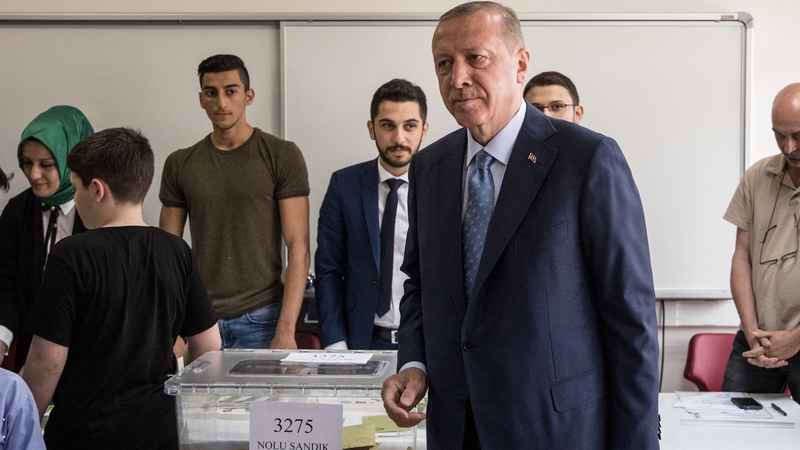
Turkish President Recep Tayyip Erdogan has declared victory in the country's presidential elections, citing what he said was a public mandate for him and the alliance led by his ruling AK Party.
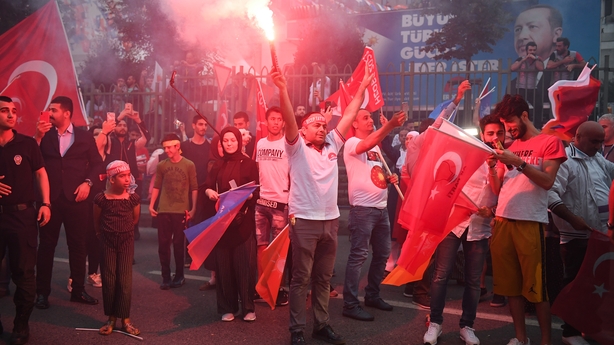
The most popular, and divisive, leader in recent Turkish history, Mr Erdogan said there would be no turning back from where he and the Islamist-rooted AK Party had brought the economy.
"Our people have given us the job of carrying out the presidential and executive posts," he said in a short speech from Istanbul.
"I hope nobody will try to cast a shadow on the results and harm democracy in order to hide their own failure."
Broadcasters had earlier reported that Erdogan had 52.8% of the vote, with 95.1% of the votes counted.
"The Turkish people have elected Erdogan as Turkey's first president/executive president under the new system. The Turkish people have said 'onwards' with President Erdogan," Turkish government spokesman Bekir Bozdag said on Twitter.
There has yet been no official declaration as of yet however.
Turkey's main opposition said it was too early to call a victory for Mr Erdogan in the presidential election, as votes from the largest cities were still not counted, adding the contest would go to a second round.
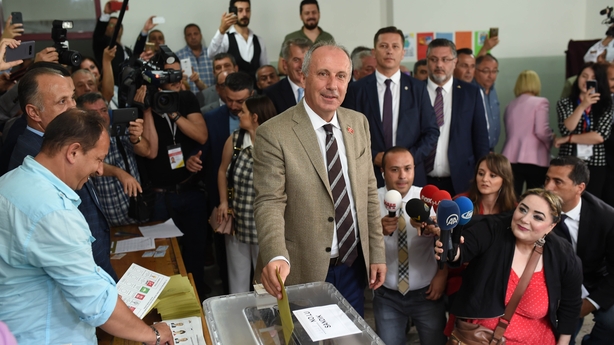
Bulent Tezcan, the spokesman for the main opposition CHP, made the comments at a news conference, citing what he said was the party's own data.
Tezcan said only 39% of the votes were counted and that Mr Erdogan won 51.7% of the votes in the elections.
Muharrem Ince, the main opposition presidential candidate, stood at 29.9% nationwide, television channels said, based off 80% of votes counted.
If no candidate wins more than 50% in the vote, a second round run-off will be held on 8 July.
In the parliamentary contest, the AK Party had 42.68%, based on 95.2% of votes counted, the broadcasters said.
The CHP had 22.55% and the pro-Kurdish Peoples' Democratic Party (HDP) stood at 10.94%.
Turnout was high at around 87% for both contests, the state broadcaster said.
The vote ushers in a powerful new executive presidency long sought by Mr Erdogan and backed by a small majority of Turks in a 2017 referendum.
Critics say it will further erode democracy in the NATO member state and entrench one-man rule.
Earlier, a crowd of Mr Erdogan's supporters chanted his name as he emerged from a school after voting in Turkey's largest city Istanbul, shaking hands with people amid tight security.
"Turkey is staging a democratic revolution," he told eporters in the polling station. "With the presidential system,Turkey is seriously raising the bar, rising above the level of contemporary civilisations."
Mr Erdogan, the most popular but also divisive leader in modern Turkish history, argues the new powers will better enable him to tackle the nation's economic problems, and deal with Kurdish rebels in southeast Turkey and in neighbouring Iraq and Syria.
Voicing opposition concerns about possible electoral fraud, Mr Ince told reporters outside the High Electoral Board (YSK) after polling stations had closed that citizens should protect ballot boxes.
He also urged YSK members to "do your job the right way", adding he believed the results would be "very good".
Opposition parties and NGOs deployed up to half a million monitors at ballot boxes to ward against fraud.
They have said election law changes and fraud allegations in the 2017 referendum raised fears about the vote's fairness.
Earlier, a CHP spokesman said the party had reported to the YSK allegations of block votes being cast and of election monitors being beaten and kept out of polling stations in the southeast's Sanliurfa province.
YSK chairman Sadi Guven told the state-owned news agency Anadolu it was taking steps in response to reports of irregularities in the town of Suruc near the Syrian border.
The government gave no immediate response to the reports, but Mr Erdogan said there had not been any serious problems.
Turkey has been under emergency rule - which restricts some freedoms and allows the government to bypass parliament with decrees - for nearly two years since an attempted coup in 2016.
Mr Erdogan blamed the coup on his former ally, US-based Muslim cleric Fethullah Gulen, and has waged a sweeping crackdown on his followers in Turkey, detaining some 160,000 people, according to the United Nations.
The president's critics, including the European Union which Turkey still nominally aspires to join, say Mr Erdogan has used the crackdown to stifle dissent.
Mr Ince told a rally on Saturday he would lift the state of emergency within 48 hours of being elected president.
He also vowed to reverse what opposition parties see as Turkey's swing towards authoritarian rule under Mr Erdogan.
