


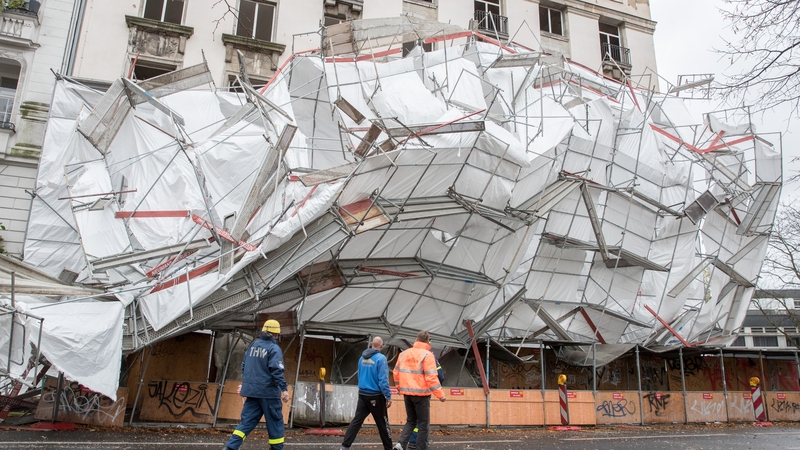
At least five people have died as strong winds hit across central Europe, killing two people in Poland, two in the Czech Republic, and one in Germany officials have said.
The victims in Poland and the Czech Republic were killed by falling trees.
The storm also knocked out power to thousands of Czechs and Poles.
The winds felled trees in the Czech Republic, with one elderly man dying after being hit in the town of Jicin northeast of Prague, and one woman was killed by a tree in a wooded area.
The weather delayed or halted traffic on several railway corridors and slowed road traffic, with a fallen tree blocking one highway just outside of Prague.
Rivers in the north reached the highest flood-alert levels.
Winds reached more than 100km/h in several parts of the country, and topped out at 180km/h on Snezka, the country's highest mountain, Czech Television reported.
The winds also hit Poland, damaging a pipeline at the country's liquefied natural gas terminal in the port of Swinoujscie.
They caused a small leak but no greater damage, according to a spokesman for the state gas pipeline operator, Gaz-System.
A driver died in his car after crashing into a branch that had fallen on the road near the northwestern city of Szczecin, firefighters said.
"At present, hundreds of thousands of households are left without power," Sona Holingerova Hendrychova, spokeswoman for the state-run power producer CEZ, said in a statement.
About 200,000 people were also grappling with power outages in the west.
In Germany, the storms caused flooding in Hamburg, where waters rose up around the city's fishmarket.
Germany's Bild newspaper reported that a 63-year-old German man drowned at a campsite in Lower Saxony as a result of a storm surge
Railway operator Deutsche Bahn closed many routes in northern and central Germany, cutting rail access to cities such as Bremen, Hamburg, Berlin, Dresden and Leipzig.
