


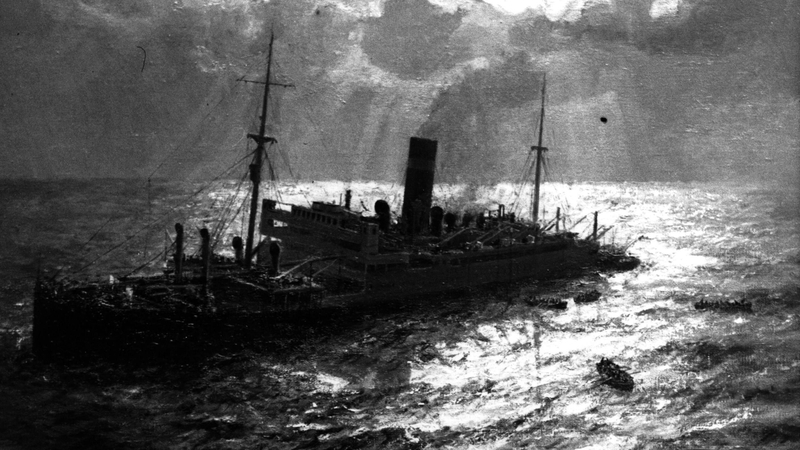
The remains of the first British ship to be sunk in World War II appear to have been identified off Rockall Bank, off the northwest coast.
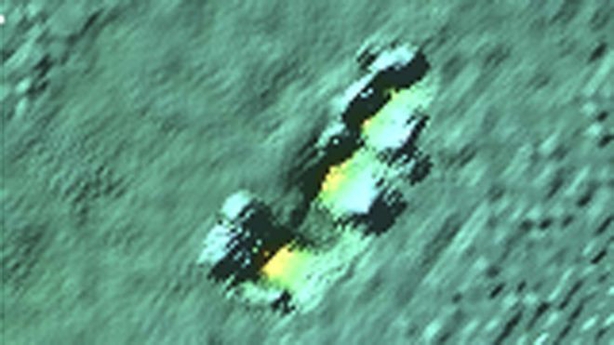
Shipwreck-hunter David Mearns says sonar data from the Geological Survey of Ireland (GSI) shows the passenger liner to be lying 200 metres down on Rockall Bank.
The Athenia was sunk without warning on 3 September 1939, killing 118 passengers and crew.
The attack came just hours after Britain had declared war on Germany.
Germany initially denied involvement, claiming one of its U-boats had mistaken the liner for an armed cruiser.
Athenia remained afloat for more than 14 hours, until she finally sank stern first at 11am the next morning.
Some of the survivors from Athenia were brought ashore from the Norwegian cargo ship MS Knute Nelson at Galway.
Mr Mearns, a marine geologist who has led the research and discovery of 24 major shipwrecks, says the GSI's data shows the Athenia's hull split in the aft section where the torpedo hit.
He told the BBC: "Can I go into a court of law and say, '100%, that's Athenia?' No. But barring a photograph I can say in my expert opinion there's a very, very high probability that that's Athenia. Everything fits."
Sailors’ Society, a charity which works internationally to support seafarers worldwide, found an account of the rescue efforts in 1939 of its Galway chaplain.
At the time, the Rev. A. J. Gailey, Presbyterian Minister at Galway, had accepted the office of Honorary Representative of the Society when a message came from the Knute Nelson to say it was carrying hundreds of survivors of the attack.
"Within 20 minutes of first hearing the news we were busy," Rev Gailey told the charity’s October 1939 edition of its Chart and Compass magazine.
"We found the port medical authority and the police and military authorities already in consultation with the Mayor of Galway. It was thus easy to arrange for the immediate coming together of a strong committee."
Groups of local residents were awarded tasks, with Rev Gailey and others getting together a volunteer squad of drivers for the next morning.
"This task we had complete by 8pm, and we then reported back to the committee who were in continuous session. We found that the ladies were already in possession of the customs shed and had the full cooperation of all the city grocers; that every hotel in town was reserving accommodation at our disposal; that a medical squad for the tender was warned and a special first aid squad for the pilot boat; and that all expenses were guaranteed for the time being.
"In company with a young priest I was allocated to the pilot-boat, which was to leave Galway at midnight. Home for a coat and rug and hot coffee in flasks. With the doctors, two police officials and the priest I joined the pilot at midnight and put in one of the most uncomfortable nights of my life.
"We were a party of 10 in a small cabin which accommodated four at a pinch and we were in the open on a rough night until we picked up the Knute Nelson at about 8am on Tuesday.
"When we came alongside we went up a rope ladder, 60 feet to deck, to meet a sight I have no desire to see again. There were nearly 600 people on a boat which had accommodation for 40 in her cabins. They were on deck, ‘tweendecks, in corridor, everywhere; but they were able to manage a cheer.
"The doctors went at once to the casualties, the police officials to the task of listing survivors, and the priest and myself about the task of talking to the nervous and anxious and bereaved. Morale was wonderful, but clothing was bizarre in the extreme.
"Some had dry clothes and some had shrunken clothes; some in night attire and some in flimsy frocks; if your boots and stockings were gone, wisps of straw did duty – or bare feet. Failing all else many had blankets. Bruises, burns, cuts were the order of the day, but everyone was making the best of it.
"In two hours we joined the tender off the harbour at Galway, and it was then that the nerves of some began to fail and they broke down. Casualties first and then the motley collection of the saved were carried or helped down to the tender where they had at last full surgical and medical aid and also food.
"With a cheer for the Knute Nelson we made for the dock and the last trans-shipment. In the customs shed was a meal for everyone who had not to go at once to hospital. By the time folk were fed they were also labelled for a hotel, and were sent off by car or bus. When all was cleared up and the victims were in their homes we were just fit to have a sort of meeting and stagger home.
"Next morning and afternoon and evening I spent in charge of the accurate detailing of information about the hospital cases an in getting in touch with their relatives. That was Wednesday and the task of clothing 500 people was well under way. Since that the authorities and our volunteer helpers have been busy at hotels, hospitals, docks, and police barracks from 9am until midnight and after.
"Some of our guests are gone and the majority seem likely to go soon; but some will remain for days yet and we have still 19 hospital cases.
"We have Americans and Canadians, British, French, Germans, Austrians, Czechs, Lithuanians and many Poles. Of the total number, crew and passengers, about 40 per cent are Presbyterian. These hail from Northern Ireland, Scotland, Canada, USA and New Zealand; 10 of them are in hospital.
"The crew were chiefly Presbyterian and were tremendously pleased to see a Presbyterian parson, albeit unshaven and dirty, tumbling over the side from the pilot-boat. Altogether the experience was unforgettable and has justified the link I have maintained for our church and the Port of Galway."
