


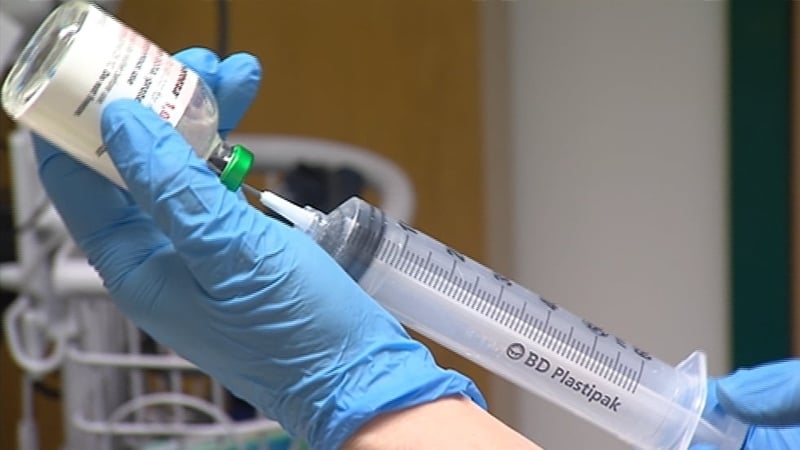
Twenty-one people receiving a drug to treat a rare lung disease through a compassionate access scheme will no longer receive the drug by the end of this month after negotiations with the pharmaceutical company failed.
The Health Service Executive decided not to add Respreeza to the reimbursement programme after assessing its clinical benefits and cost effectiveness.
The National Centre of Pharmacoeconomics said the drug "wasn't value for money" after it carried out a drug assessment.
Professor Michael Barry, the centre’s clinical director, also criticised the compassionate access scheme offered by the drug manufacturers, CSL Behring, which he said was dependent on subsequent reimbursement.
"A compassionate access scheme that is dependent on reimbursement. I don't think that's a really good idea, and I think it puts patients in a really difficult position if the decision is not to reimburse the drug," Professor Barry said.
He said that the decision not to reimburse the drug was not solely based on its cost.
"Primarily we felt that the evidence which was derived from the main clinical trial wasn't strong enough. While there was a benefit in terms of lung density on CT scanning, unfortunately clinical outcomes in terms of lung function tests, quality of life, exacerbations and indeed survival; there was no impact of this drug on any of those parameters," Professor Barry said.
"That in conjunction with the high cost of the drug - it can be anything over €80,000 per patient per year, we felt that it wasn't value for money."
We need your consent to load this rte-player contentWe use rte-player to manage extra content that can set cookies on your device and collect data about your activity. Please review their details and accept them to load the content.Manage Preferences
Respreeza is administered to patients over a lengthy period of time. Over the course of five years it would have cost the HSE in the region of €37 million.
The National Centre of Pharmacoeconomics said that drugs are becoming more expensive.
Professor Barry added: "We are seeing drugs coming to us now with price tags that we never envisaged before. It's not infrequent to see a drug at €500,000 per patient per year. In fact we are just assessing a drug that costs €1,000,000 per patient per year. It really is difficult, and we're seeing an increasing number of these products."
Meanwhile, the Alpha One Foundation has called on Minister for Health Simon Harris to reconsider the decision over the exclusion of Respreeza from the reimbursement programme.
The foundation, which aims to raise awareness about the rare lung disease that was being treated by Respreeza, said that the drug is already available and reimbursed by 12 European countries.
Geraldine Kennedy, Chief Executive of the Alpha One Foundation said: "Today's decision is a huge blow for patients with severe Alpha-1 who have been campaigning for months for the approval of Respreeza.
"We urge the Minister, the HSE, and CSL Behring to pull back from the brink. We ask all parties involved to please put patients first."
In 2016, there was a campaign to fund the drug Orkambi for patients with Cystic Fibrosis.
Asked if campaigning and lobbying works, Professor Barry said there is a finite budget and you can only fund a number of these high cost medicines. "It's gone beyond campaigning in my view."
"We know what's coming next. For example, we have cholesterol medications that could cost over a quarter of a billion euro over five years. That's the type of challenge that is on the way. I'm not so sure that campaigning for all of these is the answer.
"The answer is that the pharmaceutical industry needs to take a look at what it's doing, come to market with realistic prices and products that add value. That's the ultimate solution, and I think it's demonstrated by the fact that we can regularly get 20%, 30%, 40% price reductions. That tells you something. The prices that they are coming to us with are too high."
