


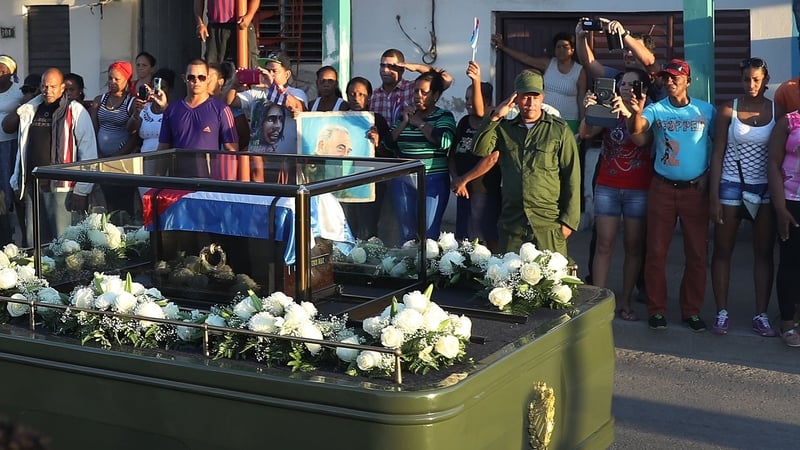
Former Cuban president Fidel Castro was buried in a "simple" funeral in the eastern city of Santiago de Cuba.
Capping a week of tributes and mass rallies, Castro was laid to rest near the mausoleum of 19th century independence icon Jose Marti and comrades of his rebellion in the eastern city of Santiago de Cuba.
A small group of guests attended the ceremony, which was closed to the public, after a jeep pulled the cedar urn into the Santa Ifigenia cemetery as thousands lined the streets, chanting "viva Fidel!"
"There were no speeches. It was very simple. There were just the ashes that were interred, the family, the government and officials," French Environment Minister Segolene Royal said after the hour-long funeral at Santa Ifigenia cemetery.
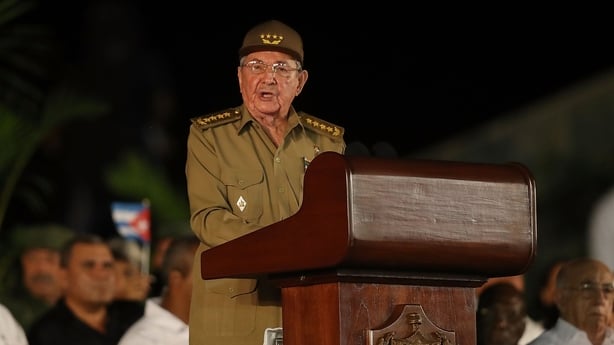
Cuban President Raul Castro earlier pledged to uphold his brother Fidel's socialist revolution at a massive rally in honour of the communist icon before his burial.
Tens of thousands of flag-waving supporters recited the oath with Raul Castro at the Revolution Plaza of Santiago de Cuba, the cradle of Fidel's guerrilla struggle.
"He demonstrated that yes we could, yes we can, yes we will overcome any obstacle, threat, turbulence in our firm resolve to build socialism in Cuba," he said.
"In front of Fidel's remains ... we swear to defend the fatherland and socialism," said Mr Castro, who took over when his brother fell ill in 2006.
"Fidel! Fidel! Until victory, always!" Mr Castro said at the evening rally attended by a few foreign leaders, including Cuba's leftist Latin American allies from Venezuela, Bolivia and Nicaragua, but also figures such as Argentine football legend Diego Maradona.
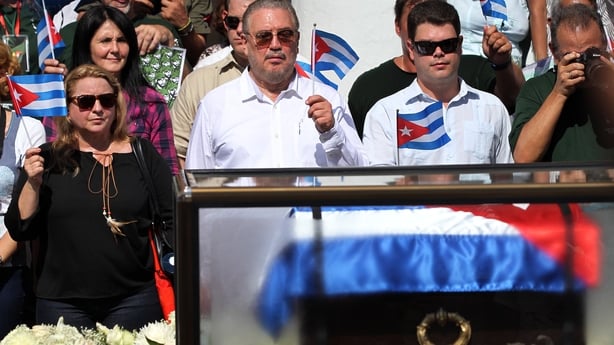
But Mr Castro said that before dying at the age of 90 on 25 November, his brother requested that no monuments or statues be erected in his honour, and that no streets or buildings be named after him.
Legislation will be presented at the next national assembly, which meets later in December, to fulfill his dying wish, Mr Castro added.
"The leader of the revolution rejected any manifestation of a cult of personality," Mr Castro said.
While he was an omnipresent figure in the lives of Cubans after taking power in 1959, Fidel Castro always opposed the construction of statues of his likeness and no streets or buildings are named after him in the country.
Castro's death has fuelled speculation over the direction the country may take without the man who ruled for almost half a century and left behind a divisive legacy.
Tearful supporters have cheered him for the free education and health care he developed on the island, while detractors call him a brutal dictator who imprisoned dissidents and ran the economy into the ground.
As Fidel has now been laid to rest, all eyes will turn to Raul Castro's next move.
While he pledged to defend the socialist revolution, the president has implemented modest economic reforms, vowed to step down in 2018 and restored diplomatic ties with the United States.
"No longer under the shadow of his older brother, Raul may now feel freer to pursue the modest economic reforms he initiated in the last decade," said Jorge Duany, director of the Cuban Research Institute at Florida International University.
Dissidents keep low profile during commemorations
Castro has been hailed in almost religious terms since his death, with the communist party newspaper Granma calling him the "eternal comandante."
The convoy carrying his ashes had arrived in Santiago following a four-day, 900km funeral procession across the country.
Children in school uniforms, veterans in military fatigues and entire families waved Cuba's flags and chanted "Fidel!" to greet the "caravan of freedom".
Fidel's supporters are certain that Raul will continue his brother's legacy.
For their part, dissidents have kept a low profile during the commemorations, calling off regular protests, although they plan to resume their demonstrations after Castro's burial and hope that Raul will implement deeper reforms.
We need your consent to load this rte-player contentWe use rte-player to manage extra content that can set cookies on your device and collect data about your activity. Please review their details and accept them to load the content.Manage Preferences
