


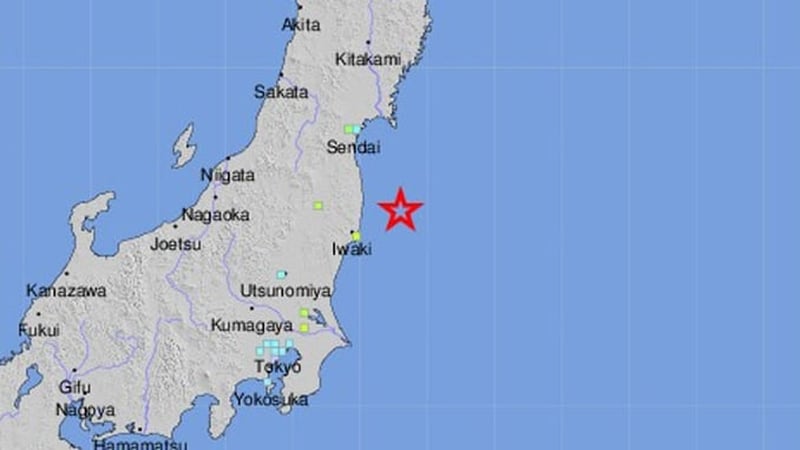
An earthquake with a preliminary magnitude of 7.3 has hit northern Japan, generating a tsunami that hit the nation's northern Pacific coast.
The earthquake, which was felt in Tokyo, was centred off the coast of Fukushima prefecture at a depth of about ten kilometres and struck at 5:59am (8.59pm Irish time) the Japan Meteorological Agency said.
A tsunami of up to 1 metre had been observed around Fukushima following the quake, which struck at 5:59am (8.59pm Irish time), public broadcaster NHK said.
A warning had been issued forecasting waves of up to 3m.
The region is the same that was devastated by a tsunami following a massive earthquake in 2011.
Tokyo Electric Power Co was checking its nuclear plants in Fukushima for damage, public broadcaster NHK said. The utility could not immediately be reached by Reuters.
Tohoku Electric Power Co said there was no damage to its Onagawa nuclear plant.
Television footage showed ships moving out to sea fromFukushima harbours as tsunami warning signals wailed.
Earthquakes are common in Japan, one of the world's most seismically active areas.
Japan accounts for about 20% of the world's earthquakes of magnitude 6 or greater.
The quake on 11 March 2011 was magnitude 9, the strongest quake in Japan on record.
The massive tsunami it triggered aused world's worst nuclear crisis since Chernobyl a quarter of a century earlier.
The US Geological Survey initially put Tuesday's quake at a magnitude of 7.3 but downgraded it to 6.9.
All nuclear plants on the coast threatened by the tsunami are shutdown in the wake of the Fukushima disaster.
Only two reactors are operating in Japan, both in the southwest of the country.
Even when in shutdown nuclear plants need cooling systems operating to keep spent fuel cool.
