

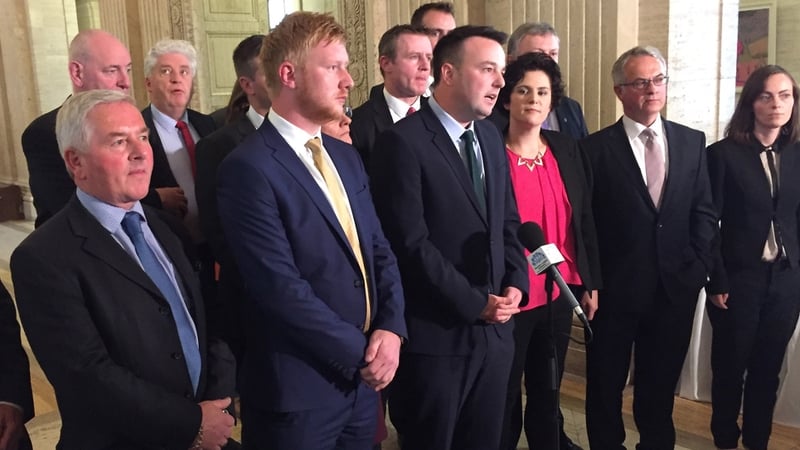
The SDLP has announced it is quitting the power-sharing administration in Northern Ireland to form part of the newly established opposition.
The move by the SDLP comes a week after fellow architects of the 1998 Good Friday Agreement, the Ulster Unionists, also opted to take their seats on the opposition benches.
With the Alliance Party having indicated its unwillingness to re-take the executive's contentious justice ministry, the new government in Belfast could be solely made up of the Democratic Unionists and Sinn Fein.
In a statement, SDLP leader Colum Eastwood said the party had made a "bold decision" to leave the executive.
The 1998 peace deal established a form of government based on a ruling coalition executive made up of all Northern Ireland's main parties.
The aim was to ensure all sections of a deeply divided society had a role in power.
While smaller parties and independents have sat outside the executive in past mandates, they have not been afforded the recognition, funding and status of an official opposition.
A new law passed earlier this year now enables parties with the electoral strength to enter the executive to instead form an opposition.
Only the UUP and SDLP have the seats to assume official opposition status and both parties have now opted to do so.
Mr Eastwood said a proposed programme for government for the next five years tabled by the DUP and Sinn Féin fell short of what the SDLP was prepared to accept.
"Today I can formally announce that, after a unanimous decision by the SDLP Assembly group and our party's Executive, over the course of this Assembly mandate we intend to form a constructive opposition to the Stormont Executive," he said.
"A new and refreshed SDLP team will now tirelessly hold this government to account. We will offer constructive criticism and offer a progressive alternative to government."
Earlier, Stormont's leaders insisted a powersharing government will be formed ahead of next week's Wednesday deadline regardless of what the smaller parties did.
The emphatic statement from DUP First Minister Arlene Foster and Sinn Féin Deputy First Minister Martin McGuinness suggested they have struck a "plan B" deal that would enable one of their parties to take on the contentious justice ministry if none of the smaller parties agree to fill it.
An inability to fill the politically sensitive justice portfolio would prevent the formation of a government in Belfast.
Both the DUP and Sinn Féin have previously vetoed the other taking the job, instead relying on the cross-community Alliance Party to fill the post.
While the DUP and Sinn Féin have opened talks with the Green Party and independent Assembly member Claire Sugden about the potential of one of them taking the job, the leading ministers made clear that, whatever happens, a justice minister will be appointed.
A short time after Ms Foster and Mr McGuinness's joint press conference, Alliance leader David Ford said he was not in a position to recommend to his party's ruling body that it should again take the justice job.
Alliance had made clear it would only fulfil the role again if it achieved progress on key policy issues.
After a brief meeting with Ms Foster and Mr McGuinness at Stormont Castle, Mr Ford said the main parties had not offered Alliance enough.
In a separate statement, Ms Foster and Mr McGuinness criticised the SDLP's actions, accusing the party of dishonesty.
"For the SDLP to now claim they do not agree with the Programme for Government process is dishonest given that they were part of developing it," the ministers said.
"The new PfG has not been plucked out of thin air. It has involved extensive consultation with political parties in the Executive, including the SDLP, dating back to last December."
