

Fewer Medical Council inquiries are being held in public, new figures show.
There were also far fewer complaints and fewer doctors involved in these complaints in 2014, compared with the previous year.
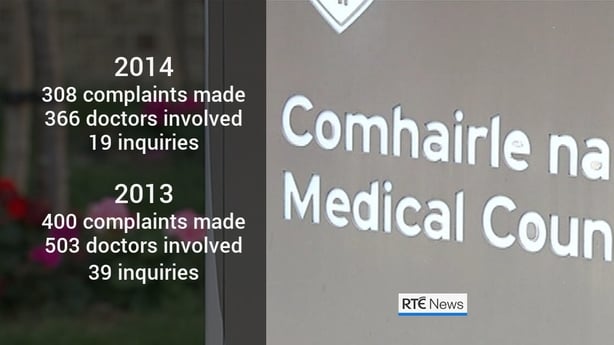
The Medical Council held four of its 19 inquiries in public last year, according to its latest annual report published today.
Nine inquiries were held in private, while another six were concluded at a preliminary private hearing.
The previous year, 25 inquiries were in public, plus two partly in public, out of 39 inquiries held.
It means that last year just over 20% of inquiries were in public, compared with well over 60% the previous year.
The Medical Council says it cannot seek to hold an inquiry in private, such a request must come from a doctor, witness or complainant.
There were also fewer inquiries last year following a High Court ruling on what constitutes poor professional performance by a doctor.
Of the 308 complaints received last year, there were 366 doctors involved.
It compares with 400 complaints the previous year, with 503 doctors involved.
Most complaints last year were about communication, dignity issues and skill levels.
Last year, the council saw a doubling of complaints alleging a failure to treat people with dignity, with 65 such instances.
Council president Professor Freddie Wood said that in light of recent events, he wanted to remind doctors to put patients at the centre of all important healthcare decisions.
In relation to fewer inquiries being conducted in public, Prof Wood said there was no change in policy but the Corbally v Medical Council case in the High Court and Supreme Court decision has had an effect.
Medical Council Chief Executive Caroline Spillane said it is important to monitor the number of private hearings and has given a commitment to report on this.
Speaking on RTÉ's News at One, Ms Spillane said a case needs to be made to justify hearing an inquiry in private.
She said a public interest test determines whether cases are held in private, usually because the issues are of a sensitive nature.
Ms Spillane added every complaint is considered and investigated by the council and a determination is made whether there should be a case for an inquiry.
She also said that while inquiries might be held in private, in a lot of cases the outcome is published on the Council's website.
The Medical Council is the regulatory body for doctors and is charged with protecting the public interest.
It has over 19,000 doctors on its register, the highest number in a decade.
Where the Council considers that an immediate suspension is necessary to protect the public, it can apply to the High Court for an order to suspend a doctor's registration, regardless of whether the doctor is the subject of a complaint.
Last year, there were five cases where the Council considered immediate suspension necessary to protect the public and this was granted by the High Court.
