


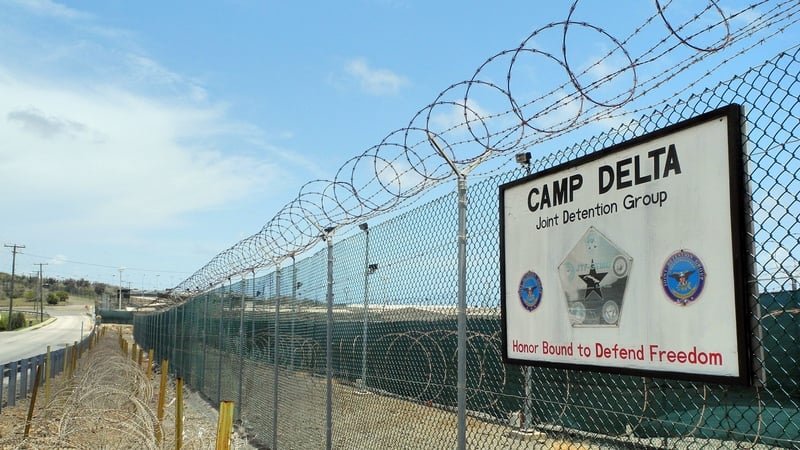
References have been made to Northern Ireland hunger strikes in a landmark US case aimed at stopping force-feeding practices on detainees at the Guantanamo Bay prison.
Syrian national Abu Wa'el Dhiab, 43, is challenging the current practices. He has been held at Guantanamo Bay for 12 years, despite being cleared for release in 2009.
He is currently on hunger strike, which his lawyer Eric Lewis described in court as "a cry for humanity".
The US District Court has heard two doctors testify that the lines between medical care and disciplinary action have been blurred at the detention centre, and that Mr Dhiab had been "provoked" into his hunger strike by the actions of the guards.
Reference has also been made to the 1981 hunger strikers in Northern Ireland.
In his opening statement to the US District Court in Washington DC, Mr Dhiab's lawyer Eric Lewis described the practice of forcibly removing Mr Dhiab from his cell, physically restraining him and then feeding him through a nasal tube, saying it was both illegal and abusive.
The court heard that unnecessary force was being used to take him from his cell to the feeding chamber, and that unnecessary force was also being used to restrain him during the process.
Mr Dhiab is 1.96m (6ft5in) tall, weighs 68kg and is emaciated. He suffers chronic back pain, as well as other ailments.
Mr Dhiab is seeking permission to use a wheelchair to attend the feeding appointments, rather than being forcibly removed by a team of military personnel wearing protective gear.
He also wants a doctor to assess him before each force-feeding.
Lawyers for the US Government have rejected that the procedure, known as enteral feeding, is inhuman and painful.
Government lawyer Andrew Warden told the court that providing medical care to Mr Dhiab was "challenging", and that he had a history of verbally and physically abusing medical staff, and had flung urine and faeces at that them on occasion.
Two doctors gave evidence to the court today that they felt the lines between medical practice and disciplinary action were blurred at Guantanamo Bay.
They visited and examined Mr Dhiab in September, spending a cumulative 15 hours interviewing him and carrying out a 90-minute medical examination.
The first witness, Dr Sandra Crosby, said that Mr Dhiab's case was complicated and needed a multi-disciplinary approach.
She said that Mr Dhiab did not have "faith or trust" in the medical staff at Guantanamo Bay because there had been a blurring of the lines between medical treatment and punishment.
Dr Crosby said that the medical staff were involved in the forcible removal of Mr Dhiab from his cell, which she said was "degrading and inhumane".
She said she had witnessed him asking a nurse for pain medication, this was denied, and when he asked to speak to the doctor, the nurse denied this request as well.
The wheelchair he had been granted to get to feeding appointments had been taken away from him as a punitive measure she said, which she described as "troubling".
Dr Crosby told the court that doctors should not be involved in disciplinary action and that it was against medical ethics.
She said doctors should be "firewalled" from such procedures, but that the distinction had been "blurred" here.
Dr Crosby said Mr Dhiab was suffering from chronic back pain, had pain and diminished ability in his right leg, right arm, and diminished feeling in the right side of his face.
Asked about her thoughts on a finding from the Joint Detention Group, which characterised his symptoms as "malingering", meaning deliberately faked in order to achieve something, she said she did not believe that was the case, based on her 20 years of treatment.
The court also heard from a retired Brigadier General in the US Military, Dr Stephen Xenakis, who held many senior positions within the US armed forces medical division.
He agreed with Dr Crosby's opinion about the blurring of lines in terms of the medical care and disciplinary procedures at Guantanamo Bay.
Dr Xenakis said he did not believe Mr Dhiab was on hunger strike because he wanted to die, but rather as a "measure of expression".
He said Mr Dhiab had been cleared for release in 2009 and was worried about when he might get to leave.
Dr Xenakis said he was often "sad" because he just wanted to get health and be with his family.
He agreed that when a hungry-striking prisoner really wants to die, then best medical practice is to respect those wishes and not intervene with feeding.
The case of the ten hunger strikers who died in Northern Ireland in 1981 was cited as an example in the court of what happened when medical authorities had not intervened.
When asked if he felt Mr Dhiab had been "coerced" into the hunger strike, Dr Xenakis said that he did not, but actually felt that he had been "provoked" into it by some of the policies and practices of the guards and medical staff at the detention centre.
The court had heard remarks during the US Government's opening statement about Mr Dhiab's violent tendencies and how he had assaulted staff on previous occasions.
However, Dr Xenakis said that he did not consider Mr Dhiab to be angry or vindictive, or that he had any anti-American or anti-Western tendencies.
He said the use of the restraint chair to insert the nasal tubing was "uncomfortable and degrading" for Mr Dhiab.
He said that a military team forcibly removing Mr Dhiab from his cell to bring him to the medical facility for force-feeding was unnecessary, and painful and demeaning for him.
Retired Brigadier General Dr Xenakis is giving evidence for Mr Dhiab's legal team, and is himself an outspoken advocate for better treatment of detainees.
He is a leading member of Physicians for Human Rights.
Judge Gladys Kessler will continue to hear the case over the next two days and will then reserve judgment pending consideration.
She has already made a significant ruling in relation to video tapes of the force-feeding of detainees.
Last Friday, she ordered the US Government to prepare public versions of 28 videos that show Mr Dhiab being force-fed.
The ruling came after a coalition of media organisations filed a motion to have the footage released.
The US government is expected to appeal the decision.
