

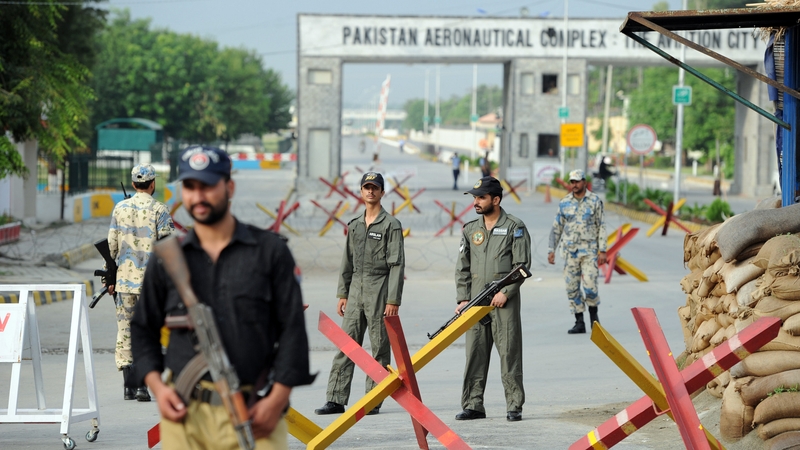
One soldier and eight suspected Islamic militants have been killed in a gunbattle at an airforce base in Pakistan overnight.
An air force spokesman said that the Minhas air base at Kamra, in central Punjab province, did not house nuclear weapons.
"No air base is a nuclear air base in Pakistan," he said.
A gunbattle raged for hours after the attack started.
Commandos were called in to reinforce and police armoured personnel carriers could be seen heading into the base.
The attackers were said to have moved through a nearby village under cover of darkness and climbed a 2.7m wall strung with barbed wire to break into the base. Some were wearing military uniforms.
The assault cast doubts over official assertions that military operations had severely weakened militants waging a violent campaign to topple the US-backed government and impose strict Islamic rule.
Security forces opened fire when militants strapped with suicide bombing vests approached aircraft hangars, prompting other militants to fire rocket-propelled grenades from outside the base's walls, the air force spokesman said.
Base commander Air Commodore Muhammad Azam, who led the operation against the attackers, was shot in the shoulder, but is in stable condition, said spokesman Captain Tariq Mahmood.
Minhas, 75km northeast of Islamabad, is adjacent to the Pakistan Aeronautical Complex, which is a major air force research and development centre.
Pakistan manufactures JF-17 fighter planes, jointly developed with China, at the site.
Suicide bombers launched attacks near the base and the aeronautical complex in 2007 and 2009, but news reports said defences were not breached.
Pakistan's Taliban movement has staged a number of high-profile attacks over the past few years, including one on army headquarters in Rawalpindi in 2009.
Last year, six Taliban gunmen attacked a naval base in Pakistan's biggest city Karachi to avenge the killing of Osama bin Laden. At least ten military personnel were killed and 20 wounded in the 16-hour assault.
Those attacks are embarrassing for Pakistan's military, which has ruled the country for more than half of its 65-year history and is seen as the most efficient state institution.
The Taliban, which is close to al-Qaeda, is blamed for many of the suicide bombings across Pakistan, a strategic US ally.
Pakistan's military, one of the biggest in the world, has staged several offensives against Taliban strongholds in the unruly tribal areas near the border with Afghanistan.
But the operations have failed to break the back of the Taliban.
Major suicide bombings have eased considerably over the past year, but that could be due to a tactical shift and not pressure from the military.
