


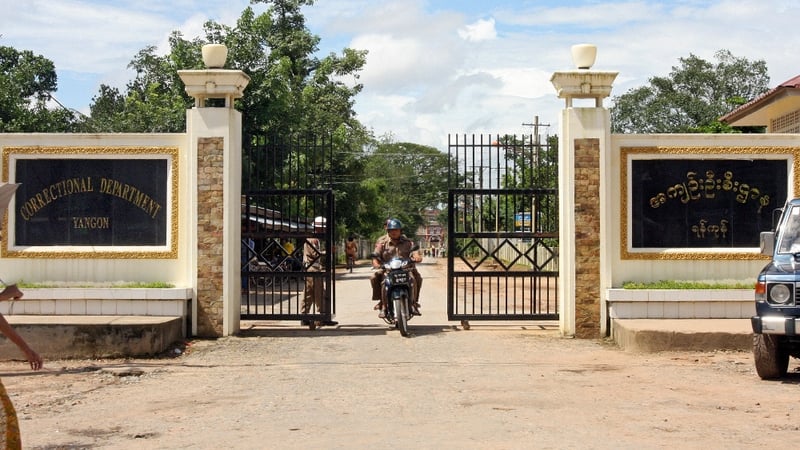
Burma has pardoned a number of prominent dissidents, journalists and a former premier under a major prisoner amnesty.
Western powers have demanded the freedom of political detainees languishing in jail in Burma, officially known as Myanmar, before they will consider lifting sanctions on the regime.
The amnesty included members of the "88 Generation Students" group, which is synonymous with the democratic struggle in Burma and was at the forefront of a failed 1988 uprising in which thousands died.
The mass pardon, which looks set to be the most significant yet under the nominally civilian government which took office last year, was hailed by democracy leader Aung San Suu Kyi's opposition party as a "positive sign".
At least two high-profile student activists involved in the 1988 protests were among those granted amnesty, along with a leading Shan ethnic minority leader and a prominent monk involved in the 2007 "Saffron Revolution".
"Years of international calls to release long-detained political prisoners seem to have pushed the government to finally do the right thing," said New York-based Human Rights Watch's deputy Asia director Elaine Pearson.
"The next step for Burma's government is to allow international monitors to verify the whereabouts and conditions of remaining political prisoners."
The authorities said about 650 inmates would be included in total, but how many are dissidents is not known. Campaigners have called for the release of all remaining political prisoners.
It is unclear whether the move will be enough to prompt a relaxation of US and EU sanctions on the regime, but Western nations appear eager to reward the regime if it shows it is genuine about wanting democratic change.
Burma's government, which in March last year replaced a long-ruling military junta, has raised hopes in recent months by reaching out to Suu Kyi's opposition party, and inviting high-profile visits from top Western officials.
It froze work on an unpopular dam supported by powerful neighbour China, and on Thursday signed a ceasefire with a major armed ethnic Karen group involved in one of the world's longest-running civil conflicts.
About 200 political detainees had already been freed in October. Estimates of the number left in prison after that amnesty ranged from between 500 and more than 1,500.
Even sceptics, however, have been surprised by the pace of the reforms.
"I said again and again (the reform process) would be excruciatingly slow, but some of the changes are excruciatingly fast," said political analyst Aung Naing Oo of the Vahu Development Institute, a Thai-based think-tank.
The country recently announced plans to hold by-elections on April 1 and Suu Kyi -- who was released from years of house arrest in November 2010 -- plans to stand for a seat in parliament in a constituency near the main city Yangon.
The 66-year-old Nobel Peace Prize winner said earlier this week that her country was "on the verge of a breakthrough to democracy".
