


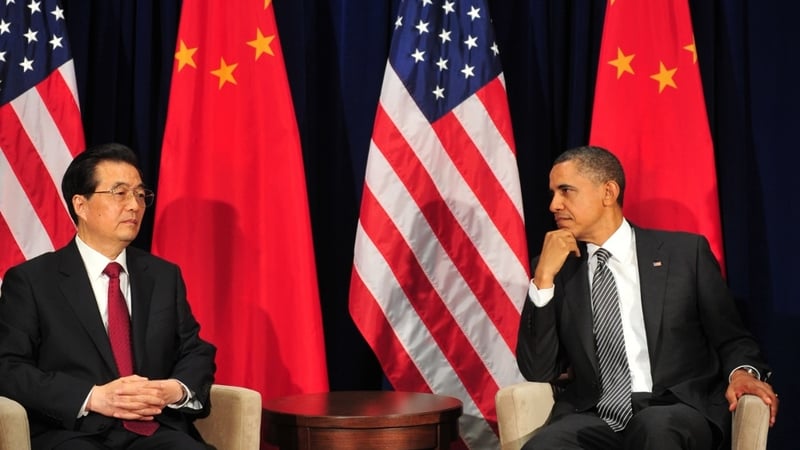
US President Barack Obama and Chinese President Hu Jintao presented different trade agendas as an antidote to weak global growth at an APEC summit that underscored the countries' growing rivalry.
The leaders of the world's two biggest economies laid out their competing visions of global trade in back-to-back speeches to corporate executives at the Asia-Pacific Economic Cooperation summit in Honolulu.
Taking China to task with some of his sharpest language yet, Mr Obama threatened punitive action unless it started "playing by the rules" on currency and trade, as he sought to reassert US influence in a region vital to America's interests.
Earlier, Mr Hu insisted on more clout for China as an emerging global power. He also made clear Beijing prefers to work through existing global trade architecture rather than allow itself to be subject to US-led efforts to pry open Asia-Pacific markets.
But when the two leaders appeared together as they started face-to-face talks, both sought to play down differences that have tested US-China ties, stressing instead the need for cooperation to tackle global challenges.
Even as Mr Obama used his meeting with executives to highlight US concerns about a rising China, he asserted the United States was partly to blame for having lost ground and said his administration was working to change that.
"We've been a little bit lazy, I think, over the last couple of decades," Mr Obama said. "We've kind of taken for granted -- well, people will want to come here - and we aren't out there hungry, selling America and trying to attract new business into America”.
Hosting the APEC summit in his native Hawaii, Mr Obama said earlier the "broad outlines" of a deal had been reached on the Trans-Pacific Partnership, a regional free trade pact being negotiated by the United States and eight other countries.
It was hailed by US officials as Mr Obama's signature achievement of the summit and a possible template for an eventual APEC-wide free trade zone.
APEC's 21 members make up the world's most dynamic region and account for more than half of global economic output.
Japan, the world's third-largest economy, formally asked to join the Trans-Pacific Partnership talks yesterday.
Mr Obama sees increased trade opportunities as an engine for job creation at home that could help him through a troubled 2012 re-election bid with the US economy still struggling.
But Beijing remains wary of the evolving trade pact that Washington is seeking with some of China's neighbours. It is widely seen as part of a US drive to provide a counterweight to China around the Pacific Rim.
With Europe's debt crisis sending shock waves around the globe, this year's APEC meeting was also emerging as a forum to push the eurozone to sort out its problems and for APEC members to strengthen defences against the fallout.
Mr Obama said he saw positive signs in Europe's efforts to tackle the crisis but there was still "work to be done" to reassure jittery markets.
