

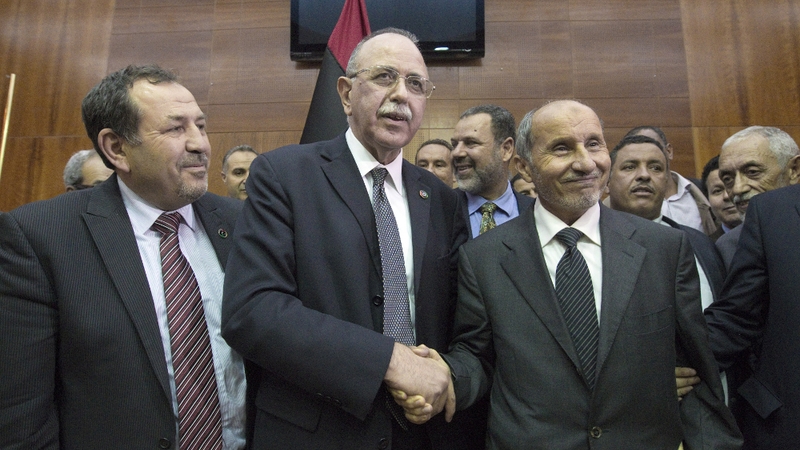
Libya's new prime minister has pledged that his interim government will set respect for human rights as its priority.
Abdel Rahim al-Keib, an academic and wealthy businessman who is a native of Tripoli, was elected interim prime minister in a public vote carried out by the members of the National Transitional Council last night.
Mr Keib told a news conference, shortly after defeating the four other candidates, that he would set human rights as a priority.
"We guarantee that we are going to build a nation that respects human rights and does not accept the abuse of human rights. But we need time," he said.
Abdel Rahim al-Keib spent decades abroad as an opponent of Gaddafi before joining the pro-democracy revolution that overthrew him.
He replaces Mahmud Jibril, who resigned three days after Gaddafi was captured and killed when NTC fighters overran his hometown of Sirte on 20 October.
"This vote proves that Libyans are able to build their future," NTC chairman Mustafa Abdel Jalil said after Monday's vote.
Under a political roadmap, Keib now has until 23 November to form an interim government that, parallel to the NTC, will run Libya for eight months after which elections for a constituent assembly will be held.
At that point the interim government and NTC will disband, giving way to a "general national congress" that the constituent assembly will form to run the country until parliamentary and presidential elections are held.
Weapon fears
The appointment of a new prime minister came as the UN Security Council called on Libya's interim authorities and neighbouring countries to stamp out the spread of weapons from Gaddafi's stockpiles.
Amid mounting fears that militant groups in Africa and beyond could get shoulder-fired rockets and other weapons from the Gaddafi cache, the 15-member council unanimously passed a resolution demanding the clampdown.
Resolution 2017, drawn up by Russia, stressed international fears that the stockpile could cause unrest through Africa's Sahel region and fall into the hands of groups such as Al-Qaeda in the Islamic Maghreb.
The resolution called on Libya "to take all necessary steps to prevent the proliferation of all arms," especially man-portable surface-to-air missiles, known as MANPADS.
