


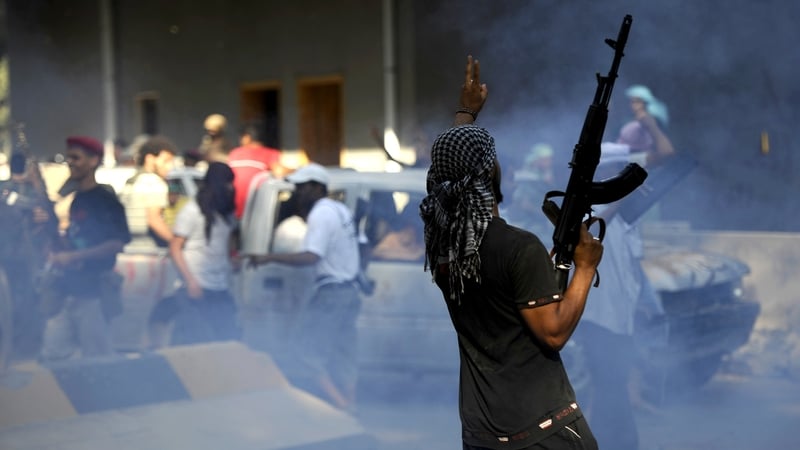
Libyan rebels are battling troops loyal to Colonel Muammar Gaddafi for control of Tripoli tonight.
Rebels launched an attack on the capital from several directions, and now say they control almost all of the city centre and surrounding areas.
However, rebel troops have come under fire from tanks based in the Gaddafi compound in western Tripoli, and there have been reports of sustained gunfire in the area throughout today.
US President Barack Obama has said the situation in Libya has reached a ‘tipping point’, and called on Colonel Gaddafi to reduce further bloodshed by standing down now, and calling on his supporters to lay down their arms.
The European Union says it is planning for a Libya without Colonel Gaddafi.
The Secretary General of the United Nations, Ban-ki Moon, said the international community was standing by to help the transitional government.
The head of the Arab League, of which Libya is a member, issued a statement expressing solidarity with the rebel government and wishing them success in leading a new era.
Meanwhile, a Pentagon spokesperson has said Colonel Gaddafi is still believed to be in Libya, although his exact whereabouts remain unknown.
Rebel forces say they have captured three of his sons, one of whom is wanted by the International Criminal Court on war crimes charges.
Civilians, who had mobbed the streets yesterday to cheer the end of dictatorship, stayed indoors as gunfire and explosions punctuated some of the heaviest fighting of the Arab Spring uprisings that have been reshaping the Middle East.
Reuters correspondents witnessed firefights and clashes with heavy weapons, including anti-aircraft guns, as rebels tried to flush out snipers and pockets of resistance. Hundreds of people seem to have been killed or wounded since Saturday.
Foreign governments which had hesitated to take sides, among them Gaddafi's Arab neighbours, Russia and China also made clear his four decades of absolute power were over.
Western powers who have mounted air strikes in support of a variety of rebel groups, urged the 69-year-old ‘Brother Leader’ to halt the bloodshed after six months of civil war that had ebbed and flowed over wide expanses of North African desert.
French President Nicolas Sarkozy, who took an early gamble on the rebels and may now reap diplomatic benefits, called on the Gaddafi loyalists ‘to turn their back on the criminal and cynical blindness of their leader by immediately ceasing fire.’
Paris offered to host a summit on Libya next week.
Egypt, still grappling with the fall of its own autocrat, abandoned its caution and recognised the rebel government. Other beleaguered Arab revolutionaries, notably in Syria, may take heart from a hard-fought triumph in the sands of Libya.
Among those detained was Saif al-Islam Gaddafi, the face of his father's rapprochement with the West over the past decade but now indicted with his father for crimes against humanity.
The International Criminal Court said it hoped to question him at The Hague, though a rebel official said Libya might try him.
A rebel official in the eastern city of Benghazi, seat of the opposition National Transitional Council, said some of its representatives had slipped in to Tripoli in recent days to make contact with authorities who had been loyal to Gaddafi with the aim of averting a breakdown of order in the capital.
Shamsiddin Abdulmolah said would-be defectors had been persuaded in recent weeks to stay in their jobs in Tripoli to help run the city.
Western leaders reiterated their refusal to commit military forces to peacekeeping in Libya, which could mean tackling rearguard loyalists using urban guerrilla tactics.
Gilmore welcomes rebel advance
Tánaiste Eamon Gilmore has welcomed events in Libya.
Mr Gilmore said he hoped the Libyan National Transitional Council would be able to establish an effective government over the whole country.
Mr Gilmore added that all remaining Irish citizens in Libya are thought to be safe.
