


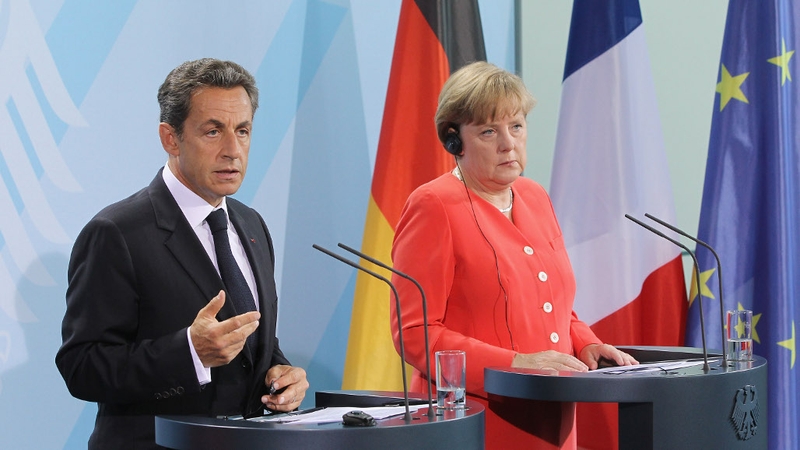
The leaders of Germany and France have said that they are united behind a new aid package for Greece that would include voluntary private sector participation on the basis of the so-called ‘Vienna Initiative’.
German chancellor Angela Merkel said this approach, based on the 2009 agreement by banks to maintain their exposures in central Europe at the height of the financial crisis, was a ‘good foundation’ for a Greek deal.
After reports yesterday that Germany wanted to wait until September to seal a new aid deal for Athens given disagreements over the role of the private sector, Ms Merkel said: ‘The quicker we get a solution the better.’
‘The Vienna Initiative ... is a good foundation and I believe that we can move forward on this basis,’ she told reporters at a joint news conference with French president Nicolas Sarkozy.
Her backing of the Vienna solution represented a shift for Berlin, which earlier this month had said in a letter to its eurozone partners that they wanted a more far-reaching bond swap to ensure fair burden-sharing from the banks that hold Greek sovereign debt.
‘We have to move forward on this now and I think it makes sense to involve the private sector. This is important for us,’ she said.
Mr Sarkozy listed four criteria that must be met to ensure a role for the private sector, including that it be voluntary, avoid creating a ‘credit event’, have the backing of the European Central Bank and be sealed rapidly.
‘We want to go as quickly as possible without fixing a date,’ Mr Sarkozy said. ‘Since September is not as quickly as possible and we may have other concerns in August and we are in the second half of June, you see what I mean.’
The Vienna Initiative was launched at the height of the financial crisis triggered by the collapse of investment bank Lehman Brothers.
It was intended to ensure that parent bank groups publicly committed to maintaining their exposures and recapitalising their subsidiaries in central and eastern European countries as part of financial aid packages from the European Union and the IMF.
Papandreou names new cabinet
Today’s comments from Mr Sarkozy and Ms Merkel come as Greek Prime Minister George Papandreou has named a new cabinet to muster support for painful economic reforms.
Current defence minister Evangelos Venizelos has been appointed finance minister.
Outgoing finance minister George Papaconstantinou will become environment minister in the reshuffle.
Mr Papandreou delayed the announcement of the new team late yesterday in what looked like a signal he was struggling to find a suitable person for the key financial post.
The political upheaval has pounded markets and drawn criticism from other European Union states, where policymakers dithered over how best to keep funding Greece and forestall a 'credit event' that could cause global economic havoc.
Three deputies have quit from Mr Papandreou's Socialist Party in as many days in protest at a five-year €28bn austerity package that the EU and International Monetary Fund have set as a condition for more aid.
Two of the three abandoned Mr Papandreou yesterday following a failed bid to form a ruling coalition with the conservative opposition.
They will be replaced with party loyalists, leaving the Prime Minister's thin parliamentary majority intact.
The protests against the measures, which include plans to raise €50bn through privatisations, have combined with political infighting and eurozone indecision to severely spook international markets.
EU must act now to make financial system more robust - IMF
Meanwhile, the IMF has said that the EU has little time left to resolve sovereign debt problems, amid rising concerns among investors and the public.
'Policy-makers must act now to make the financial system more robust,' the IMF said in a report issued in Sao Paulo.
'The current window of opportunity to prepare the financial and economic system against potential systemic shocks, importantly by providing clarity on euro area-wide solutions to strains in the periphery, could close unexpectedly.'
The IMF noted that concerns about debt sustainability and support for adjustment efforts in the eurozone periphery had intensified, in an update of its April Global Financial Stability Report.
The IMF highlighted that worries about the bailed-out eurozone periphery economies of Greece, Ireland and Portugal have renewed the market's focus on the potential for contagion of shocks to banks.
Banking systems in core European countries, such as Germany and France, still have large exposures to peripheral countries, and the pace of banking system repair has been too slow, it warned.
A market shock could come from an unexpected sudden pick-up in risk aversion that 'leads market participants to narrow their tolerance for incomplete policy solutions.'
'It could also be closed by political developments, either because adjustment programs lose political support in debtor countries, or because populaces in creditor countries lose patience in continuing to finance those programs,' the IMF said.
'Thus, a more robust financial system, notably in Europe, is needed to gird against shocks.'
China weighed in again earlier today, with Vice Foreign Minister Fu Ying saying it was 'vitally important' Europe sorted out its debt mess.
Earlier this week, China's central bank said the European debt crisis could spread and worsen.
Chinese Premier Wen Jiabao visits Hungary, Britain and Germany next week and the European debt crisis is expected to be high on his agenda.
China has invested an estimated 25% of its $3.05 trillion foreign exchange reserves, the world's largest, in the euro.
The White House said it was monitoring the situation and that the Greek debt crisis was a headwind to the US economy.
