


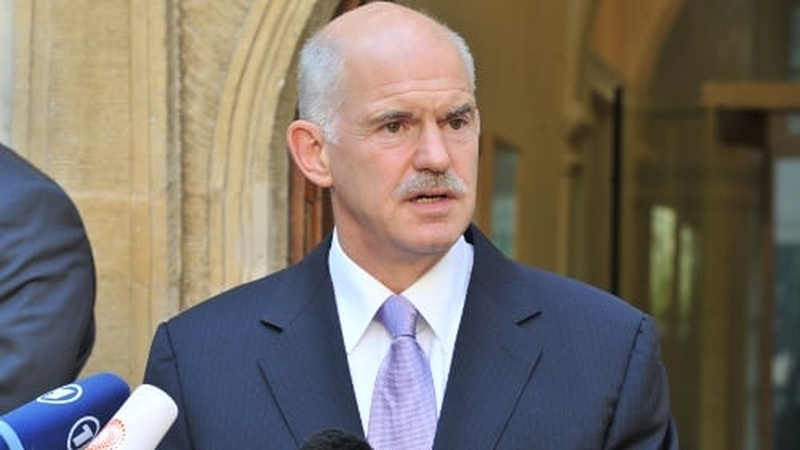
The Greek government has warned dissenters in the ruling party against rejecting an austerity plan agreed under a new international bailout deal.
Prime Minister George Papandreou met senior members of his socialist party to try to stem an outbreak of unrest over the social cost of the bailout before it turns into a full-scale parliamentary rebellion.
Tens of thousands of Greeks are protesting regularly against waves of austerity demanded by the European Union and the International Monetary Fund, as well as against corruption and state mismanagement.
Workers at state firms earmarked for privatisation have called a strike for later today.
But Mr Papandreou told his PASOK party's political council that the extra austerity included in a new 2011-2015 fiscal plan, which will be submitted to parliament this month, is necessary to stem the crisis.
'The time has come to move with greater boldness ... always in a democratic way but with determination and unity in the great changes the country needs,' he said.
'This means that we must proceed responsibly in finishing and passing the medium-term plan.'
Greece has agreed to €6.48bn worth of extra austerity measures for this year and more savings up to 2015 to cut deficits.
The plan also lays out years of austerity and faster privatisation, agreed with the EU and IMF to secure the second financial rescue in just a year.
PASOK says it inherited the debt and budget crisis when it defeated the conservative New Democracy party in 2009, but has repeatedly stressed it aims to serve its full four-year term.
'For us it would have been very easy to say 'Let us have elections, why carry this bomb we inherited to the end'?' government spokesman George Petalotis told Real FM radio. 'Elections would have worse consequences for the country.'
Opinion polls show PASOK's lead over New Democracy has vanished, suggesting that new elections could produce a stalemate during which the latest IMF/EU rescue could unravel.
Greeks are suffering as unemployment climbed to 16.2% in March, the highest in the eurozone after Spain.
Industrial production dropped 11.0% year-on-year in April as Greece suffers its third year of recession, public spending cuts and higher taxes.
Meanwhile, The European Central Bank has signalled an interest rate hike will take place in July to fight soaring inflation.
The ECB warned that any policy step that risked a Greek debt default would be 'an enormous mistake.'
Speaking after the ECB left its main interest rate on hold, president Jean-Claude Trichet said the bank's position on inflation was one of 'strong vigilance', widely considered a code for tightening monetary policy in the eurozone.
IHS Global Insight chief economist Howard Archer has said that 'the ECB left little doubt that it will hike its key interest rate from 1.25% to 1.50% at its July meeting.'
