


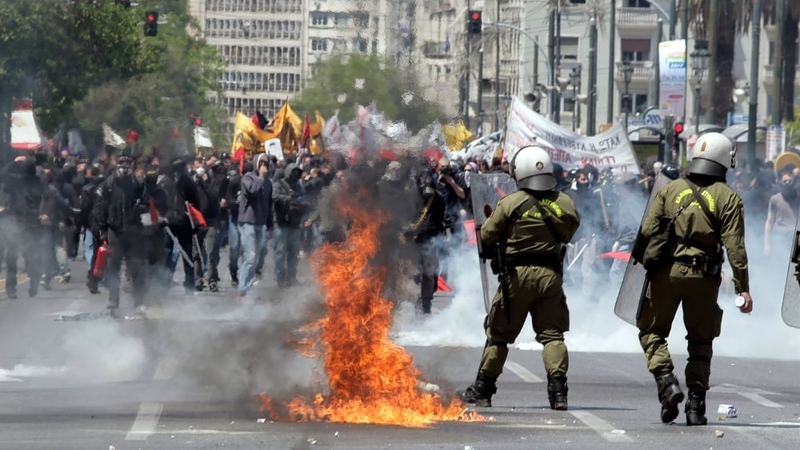
Greek police have clashed with stone-throwing youths as thousands of people protested against austerity measures in Athens.
The protests came on the day European Union and International Monetary Fund officials began talks with the government on stepping up fiscal reforms.
After bailing out Greece one year ago, European governments have concluded that additional aid may be necessary.
Greece is struggling to meet its economic targets and win back the confidence of investors, who now believe the country will eventually have to restructure its debt mountain.
EU finance ministers will discuss the Greek crisis next week but are not expected to decide on any new support measures until the EU-IMF mission gives its verdict on progress on reforms.
A eurozone source told Reuters news agency that the ministers were likely to tell Greece it must deliver on savings and privatisation targets already agreed if it wants new emergency financing next year.
'There will be debate on Greece next week. No decision will be taken,' Joerg Asmussen, Germany's deputy finance minister said.
The EU/IMF mission to Greece will focus on a 2011-2015 fiscal plan and on Greek progress in raising €50bn from privatisations.
Markets are braced for some form of debt restructuring in the long-run as Greece labours under a €327bn debt mountain.
Ten-year Greek bonds currently change hands at around 55% of their face value, carrying a secondary market yield of 15.7%.
They were little changed today but up more than 3% since the start of the year.
One year into their austerity plan, Greeks are tiring of sharp spending cuts and tax rises that threaten their way of life.
Police fired teargas at protesters in Athens and some 20,000 protestors - fewer than in previous demonstrations - marched to parliament as part of a 24-hour nationwide strike against the Socialist government's austerity drive.
'People feel they can't make ends meet and at the same time believe that these policies are not effective. This is an explosive mix,' said Costas Panagopoulos at ALCO pollsters.
The EU's Economic and Monetary Affairs Commissioner has said that Greece needs to put domestic disputes aside and that there needs to be cross-party support for the country's economic recovery.
Olli Rehn said that the country's political forces, both in government and opposition, now faced a real test of credibility.
Elsewhere, in a positive sign for Portugal, Finland's Prime Minister-elect Jyrki Katainen said he had reached a deal with the Social Democrats to back a bailout for Portugal.
That came after Finland's eurosceptic True Finns party had promised to vote against the aid package in parliament, which is a key hurdle for the bailout.
