


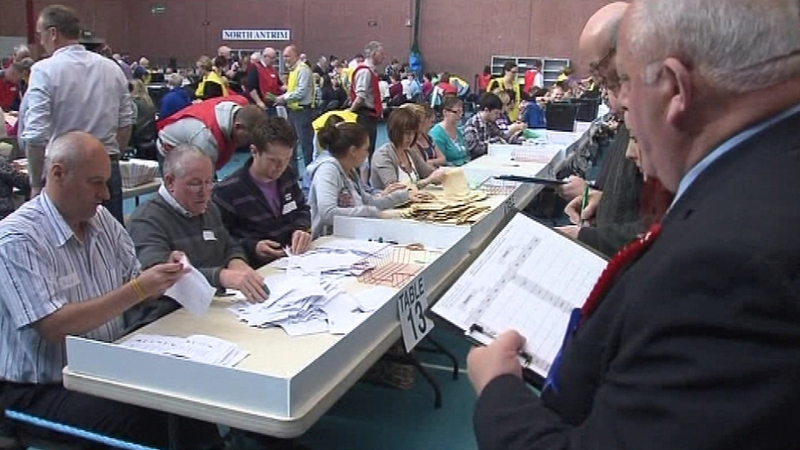
The DUP and Sinn Féin were tonight poised for a resounding success in the Northern Ireland Assembly elections, with predictions of significant losses for the UUP.
Elsewhere, SDLP leader Margaret Richie has topped the poll in South Down.
With 8,506 first preference, she was comfortably ahead of Caitríona Ruane of Sinn Féin who got 5,955 first preference votes. Jim Wells of the DUP received 5,200 votes.
With the quota of 5,961, Margaret Richie was declared elected on the first count. Her surplus is now being distributed.
Northern Ireland is divided into 18 constituencies, each with six Assembly seats.
The checking and counting of votes began in eight centres at 8am with the first results now coming in.
The results will come against the background of a record low voter turnout - which is predicted to reach a figure of 55% or lower.
The election process has also been hit by slow vote counting across Northern Ireland, with the first handful of results declared 20 hours after the polls closed and ten hours after ballot boxes were opened.
Election officials blamed the complexity of having to deal with ballot papers from the Assembly election, local council elections and the UK-wide AV referendum at the same time.
But tallies of party performance gave clear indications of a strong showing by the DUP and Sinn Féin, as well as gains for the cross-community Alliance Party.
DUP leader Peter Robinson said: 'It is very pleasing and rewarding to hear that right across the province our candidates are doing so well because they put a lot of work into it.
'We didn't ask for a mandate from the people to enhance the standing of the Democratic Unionist Party, we asked for a mandate to keep Northern Ireland moving forward.'
Mr Robinson was set to romp home in East Belfast despite having the lost the constituency's Westminster seat in the general election.
The DUP leader has since made a major political recovery, but he declined to comment on his likely revival in East Belfast until the votes were counted.
Sinn Féin's Martin McGuinness said there was ‘considerable dismay’ over the delay in vote counting.
But he welcomed indications of success for Sinn Féin and said the electorate was endorsing the parties who had co-operated to deliver for people at Stormont.
His claims were endorsed by his party President Gerry Adams who visited the count centre dealing with his former west Belfast constituency.
Mr Adams said he believed his party was set to have a good election.
Mr Adams said the Ulster Unionist Party (UUP) and the SDLP both held seats in the last ministerial Executive at Stormont, but had criticised the conduct of the DUP and Sinn Féin, who were the dominant presence in the outgoing administration.
The smaller parties had tried to criticise the Northern Assembly, despite being part of it, and now appeared to have been punished by voters, Mr Adams said.
He added: 'I think the problem for the SDLP and the UUP is that rather than joining in the Executive, keeping their own particular identity and working with the rest of us, they tried to cast themselves very artificially as being in government and opposition at the same time. That doesn't work.’
The final shape of the 108 seat Stormont legislature will not be known until tomorrow evening.
But the delays in counts were not all blamed on the complexity of the process.
In the Omagh count centre electoral staff reportedly used hairdryers to peel apart votes that had become sodden when a ballot box got wet in the rain.
If forecasts of a turnout of 55% or lower are proved correct, it would be far behind the figure for previous elections.
Assembly elections had a 69.9% turnout in 1998, 63.9% in 2003 and 62.9% in 2007. Last year's general election saw 57.6% turnout in Northern Ireland.
Some of the earliest confirmed turnout figures showed 48% in East Antrim, 57% voted in Foyle, 53% in Lagan Valley, 46% in North Down, 55% in Upper Bann and 64% in the mainly nationalist West Tyrone constituency.
Britain votes no to Alternative Vote
Proposals to change the way British MPs are elected were decisively rejected by voters in a referendum across the UK.
With almost three-quarters of the votes counted, the No campaign had established an unassailable lead of around 69% to 31%, securing victory in almost every corner of the country.
Senior Liberal Democrats - who had led the campaign for the Alternative Vote - conceded defeat and acknowledged that their long-cherished dream of electoral reform is now off the agenda at least until the end of the Parliament.
The rejection of AV, under which voters rank candidates in numerical order, was a further humiliation for Deputy Prime Minister Nick Clegg, for whom a referendum on voting reform was his main prize in negotiations to form a coalition last year.
But prominent Lib Dems insisted that, despite the setback on electoral reform and the party's disastrous showing in elections to English councils, the Scottish Parliament and Welsh Assembly,
Mr Clegg's position was safe and the coalition would survive.
After 296 of the 440 referendum declarations, the No campaign had 68.56% of the vote against 31.44% for Yes.
SNP takes control of Scottish parliament
Scottish National Party (SNP) leader Alex Salmond pulled off an unprecedented victory in the Scottish Parliament election, clearing the way for a referendum on independence.
Flying into Edinburgh by helicopter, he pledged to ‘make the nation proud’ after his party won 69 of 129 seats.
Speaking after landing in the grounds of Prestonfield House Hotel, he welcomed promises of constructive opposition from the leaders of Labour and the Liberal Democrats.
Mr Salmond added: ‘This party, the Scottish party, the national party, carries your hope. We shall carry it carefully and make the nation proud.’
