

Britain has expelled the Libyan ambassador after its embassy in Tripoli was attacked.
It followed a NATO air strike that reportedly killed a son of Colonel Muammar Gaddafi in the city.
It is reported the embassy was one of a number of foreign missions in the Libyan capital which were targeted by crowds of people angered by the air strike.
NATO has defended its operations and said it was aware of what it called ‘unconfirmed’ reports that some of Colonel Gaddafi's family members may have been killed and said it regretted all loss of life.
However, it said all NATO targets were military, and it did not target individuals.
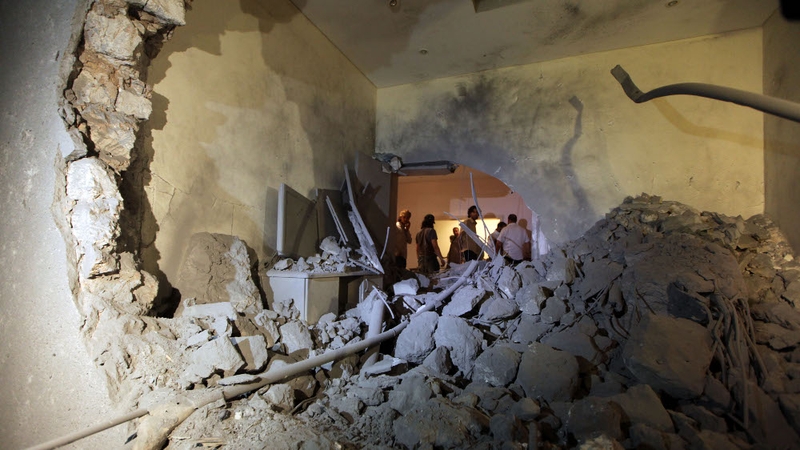
Libyan officials took journalists to the house in Tripoli, which had been hit by at least three missiles.
The roof had completely caved in in places, leaving mangled rods of reinforcing steel hanging down among splintered chunks of concrete.
'What we have now is the law of the jungle,' government spokesman Mussa Ibrahim told a news conference.
'We think now it is clear to everyone that what is happening in Libya has nothing to do with the protection of civilians.'
The deaths have not been independently confirmed.
The UN international staff in Tripoli have left Libya because of unrest in the capital.
The 12 staffers left after attacks by demonstrators on the British and Italian embassies in Tripoli.
UN officials said their Tripoli offices were ransacked overnight, according to several media reports, but the United Nations statement did not confirm any attack.
The statement said the international staffers would cover Western Libya from neighbouring Tunisia.
The United Nations sent international staff to Tripoli only last month after OCHA chief Valerie Amos reached an agreement with the Libyan government on a humanitarian presence.
The UN also has international staff in Benghazi, the principal city in the rebel-controlled eastern part of Libya.
NATO has denied targeting Gaddafi, or his family, but said it had launched air strikes on military targets in the same area of Tripoli as the bombed site seen by reporters.
'NATO continued its precision strikes against regime military installations in Tripoli overnight, including striking a known command and control building in the Bab al-Aziziyah neighbourhood,' the alliance said in a statement.
NATO's commander of Libya operations, Canadian Lieutenant-General Charles Bouchard, said the target was part of a strategy to hit command centres that threaten civilians.
'All NATO's targets are military in nature ... We do not target individuals,' he said in a statement.
Mr Ibrahim said Gaddafi's youngest son, Saif Al-Arab, had been killed in the attack.
Saif al-Arab, 29, is one of Gaddafi's less prominent sons, with a limited role in the power structure.
Mr Ibrahim described him as a student who had studied in Germany and said the grandchildren killed were pre-teens.
The appearance of an assassination attempt against Gaddafi is likely to lead to accusations that the British- and French-led strikes are overstepping the UN mandate to protect civilians.
'I am aware of unconfirmed media reports that some of Gaddafi's family members may have been killed,' said Gen Bouchard. 'We regret all loss of life.'
'The leader himself is in good health. He wasn't harmed,' Mr Ibrahim said. 'His wife is also in good health.
'This was a direct operation to assassinate the leader of this country. This is not permitted by international law. It is not permitted by any moral code or principle.'
British Prime Minister David Cameron reiterated that NATO's policy in Libya is not about targeting 'particular individuals'.
Mr Cameron said: 'The targeting policy of NATO and the alliance is absolutely clear. It is in line with the UN resolution 1973.
'It is about preventing a loss of civilian life by targeting Gaddafi's war-making machine, so that is obviously tanks and guns, rocket launchers, but also command and control as well.'
Chavez criticises 'murder' attempt
Venezuelan President Hugo Chavez, a long-time ally of Gaddafi, called it attempted murder.
'There is no doubt the order was given to kill Gaddafi. It doesn't matter who else is killed, kill Gaddafi ... a murder, this is a murder,' he said in Caracas.
Gaddafi, who seized power in a 1969 coup, is fighting an uprising by rebels who have seized much of eastern Libya. He describes the rebels as religious extremists and Western agents who seek to control Libya's oil.
It appeared to be the second NATO strike near to Gaddafi in 24 hours.
A missile struck near a television station early yesterday when the Libyan leader was making an address in which he said he would never step down and offered talks to rebels.
The rebels insist they cannot trust Gaddafi. The last few days have seen fierce shelling of rebel outposts in the west.
A rebel spokesman in the mountain town of Zintan said government forces has showered the city with up to 30 powerful Grad missiles late in the evening.
Tripoli has also declared a sea blockade on the western outpost of Misrata, potentially robbing the rebels of a vital aid link to their eastern heartland.
Celebratory rifle fire and car horns rang out in the rebels' eastern capital of Benghazi as news of the attack spread.
Elsewhere, artillery fire from forces loyal to Libyan leader Muammar Gaddafi landed in the Tunisian border town of Dehiba, a Reuters correspondent in the town said.
The correspondent said most of the shells landed in the outskirts of the town, where there are only a few houses.
There were no reports of any casualties. Pro-Gaddafi forces have been fighting rebels on the Libyan side of the border.
