


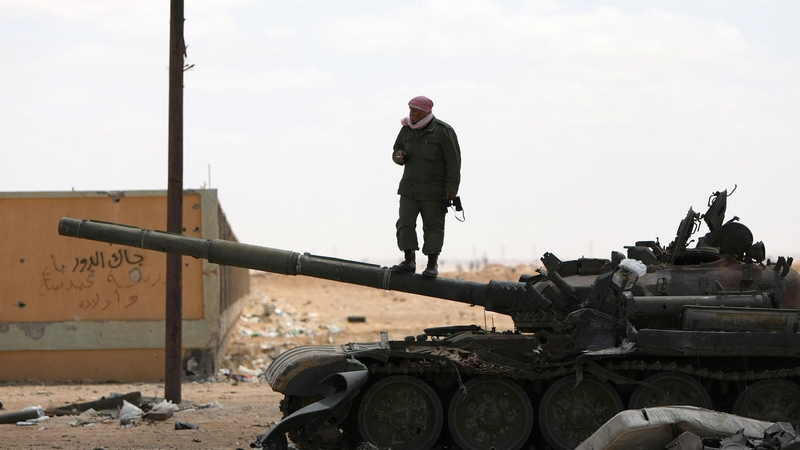
Libyan rebels are fighting to take Misrata's airport after pushing back Muammar Gaddafi's forces from the city's lifeline sea port.
Meanwhile, a United Nations panel has arrived in Libya to investigate violence and human rights abuses.
Rebels in Misrata say they are confident victory is 'very close' for them in the strategic port city.
'Our freedom fighters have managed to defeat the soldiers of Gaddafi' by forcing them out of Misrata, Khalid Azwawi, head of the local transition committee, told a news conference last night.
'They managed to force them to leave, but not very far. That's why Gaddafi is trying to bomb the port,' he said.
Rebel fighters backed by NATO air strikes said yesterday they drove Gaddafi's troops out of missile range of the port of Misrata, an aid conduit for the city of 500,000 people under siege for more than seven weeks.
The fighting continued around Misrata's airport this morning, according to the rebels.
'Significant Gaddafi forces were concentrated around the airport a few kilometres west of the besieged city,' rebel military chief Ibrahim Bet-Almal said, noting 'cooperation between (his) forces and NATO.'
'We're trying to clear this area on the city's outskirts' which was rocked by continuous explosions last night as missiles and rockets fell randomly, he said.
Meanwhile, the US opened another lifeline by authorising Americans to buy oil, gas and petroleum products from the rebels' Transitional National Council.
'The people of Libya are brave and defiant but we need access to oil revenues so that we can feed, protect and defend our families,' the council said in welcoming the move by the US Treasury Department.
Overnight, the UN said a three-member international panel arrived in Libya to begin a UN-ordered inquiry into the violence and abuses since Gaddafi's forces began a crackdown against protestors in mid-February.
The team is led by Egyptian war crimes expert Cherif Bassiouni and included Jordanian-Palestinian lawyer Asam Ader and Philippe Kitsch, a Canadian who was the first president of the International Criminal Court.
The inquiry was 'ordered after reports emerged of serious human rights abuses against civilians in Libya, where initially peaceful protests have transformed into open conflict between opposition groups and the Gaddafi regime,' it said.
Meanwhile, chiefs or representatives of 61 tribes from across the North African country called for an end to Gaddafi's four-decade rule, in a joint statement released yesterday by French writer Bernard-Henri Levy.
'The Libya of tomorrow, once the dictator has gone, will be a united Libya, with Tripoli as its capital and where we will at last be free to build a civil society according to our own wishes,' it said.
Mr Levy has become an unofficial spokesman in Paris for the revolt and is credited with pressing President Nicolas Sarkozy to mobilise international political and military support for it.
