


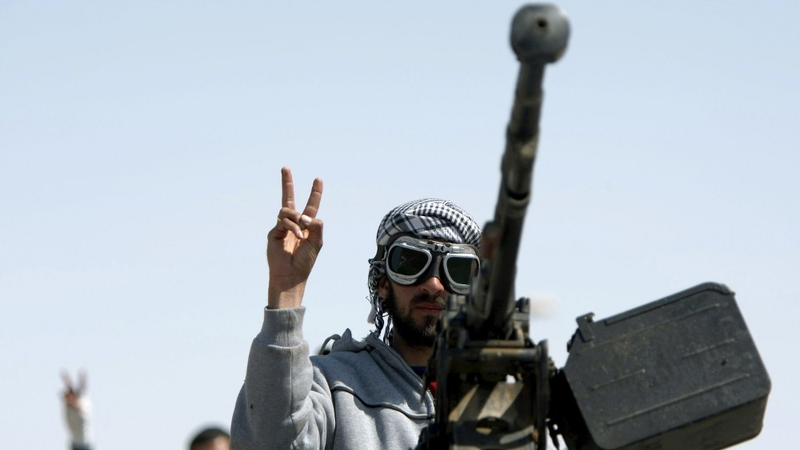
France does not plan to start arming opposition rebels in Libya although it does not oppose others doing so, a presidential source has told Reuters news agency.
The source, who was at bilateral talks in Paris on Libya between President Nicolas Sarkozy and British Prime Minister David Cameron, said France did not believe UN resolution 1973 prohibited arming the rebels to defend themselves against Muammar Gaddafi's army.
But it saw no reason today to send weapons.
‘We are not doing it,’ the source said. ‘And nor are the British as far as I know... It's a decision that's been taken but that does not mean we oppose those that do.
‘It doesn't seem necessary today because the national transition council is not having problems finding the weapons they need and friends to show them how to use them.’
The meeting between Mr Sarkozy and Mr Cameron took place following a summit earlier today in Doha, where foreign ministers discussing Libya's future said that Gaddafi must leave soon and that rebels fighting against him should receive material support.
'Participants remained united and firm in their resolve,' the ministers, who form the ‘contact group’ for dealing with Libya, said in a final statement in Doha.
'Gaddafi and his regime has lost all legitimacy and he must leave power allowing the Libyan people to determine their own future.'
The language indicated a stronger stance than that seen at the group's meeting two weeks ago, reflecting increased pressure from Britain and France.
They are delivering most of the air strikes on Gaddafi's armour and want other NATO members to contribute more to the alliance's efforts in Libya to end the deadlock in the country's civil war.
The 'contact group', who will next meet in May, said they would work with the national council rebel group to set up a temporary financial mechanism.
This refers to an idea floated earlier of establishing a fund to help rebels using frozen assets.
'Participants agreed that a Temporary Financial Mechanism could provide a method for the INC (interim national council) and international community to manage revenue to assist with short term financial requirements and structural needs in Libya.'
Speaking in Doha, rebel spokesman Mahmud Shammam said 'we want to move from the de facto recognition of the council to an internationally recognised legitimacy.'
Tripoli
A loud explosion was heard in Tripoli this afternoon and the Al Arabiya television station reported two explosions close to Tripoli's airport.
NATO said it had conducted an airstrike close to the capital.
'We can confirm there was a deliberate air strike on munitions bunkers roughly 13km southeast of Tripoli,' a NATO official said when asked about the explosions.
He gave no more details.
Elsewhere, there were reports that rebels and Gaddafi forces again clashed in the mountainous western region around Zintan.
Transitional National Council official Ali al-Isawi said Gaddafi's troops had killed 10,000 people since the rebellion broke out in mid-February, with another 30,000 wounded and 20,000 missing.
Those figures have not been independently confirmed.
Meanwhile, French Foreign Minister Alain Juppe said the coalition force must keep up strong military pressure on Gaddafi's troops to convince him there is no way out.
Mr Juppe said better coordination was needed between NATO and the Libyan opposition national council over targeted air strikes.
'The aim is very clear, Gaddafi must go but we need a political solution,' Mr Juppe told reporters in Doha.
'We must keep up a strong and robust military pressure to convince Gaddafi there is no way out.
'We have asked NATO to apply in a robust way the mission granted by (United Nations) resolution 1973.
'We have to ensure the aerial resources and capacity are sufficient. You know that France has supplied a third of the planes that can be used.'
