


There are reports of explosions in the Libyan capital, with one blast occurring close to the residence of Colonel Gaddafi.
Sporadic explosions and heavy gunfire have been heard within the past hour in the centre of the city of Benghazi.
Click here for the latest updates from the crisis
The blasts came after Libya's armed forces called on all units to observe an immediate ceasefire as a coalition of western forces continued air strikes.
A United States military official has said the no-fly zone approved by the United Nations Security Council on Thursday is now effectively in place over Libya.
At a media briefing, Vice Admiral William Gortney questioned the ceasefire and 'anything else called for by Colonel Gaddafi' but added that the coalition forces were not targeting the Libyan leader.
He said the airstrikes were deemed to be effective in degrading the Gaddafi regime's air defences, but it was not yet clear how long the strikes would last.
The head of the Arab League criticised the coalition attacks, saying Arabs wanted the protection and not the bombardment of civilians.
Secretary-General Amr Moussa said the Arab League did not want military strikes when it had called for a no-fly zone over Libya, and that he would be calling for an emergency meeting to discuss the situation.
US Defence Secretary Robert Gates said tonight that the future of Libya remained unclear.
He said partitioning would be a formula for what he called 'enduring instability'.
Mr Gates also said he believed there was a sensitivity within the Arab League to being seen to operate under the umbrella of NATO.
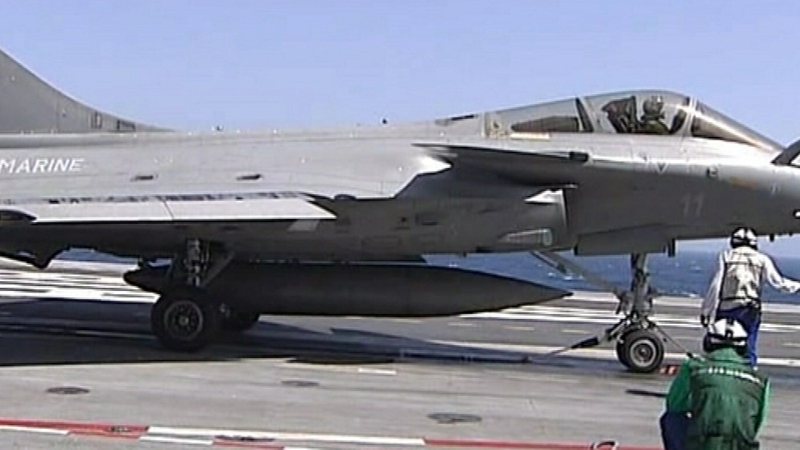
The French military has said its warplanes encountered no opposition in enforcing a no-fly zone over Libya today.
Earlier, the US military said that 20 of 22 targets were struck in last night's air and sea attacks by coalition forces in Libya.
‘It looks like things have gone well as far as the strikes are concerned. We had 20 of 22 targets hit,’ said AFRICOM spokesman Lieutenant Commander James Stockman.
‘The other two targets are still under assessment,’ he added.
The Chairman of the US Joint Chiefs of Staff, Admiral Mike Mullen, said the coalition's raids have been successful. He added that the coalition forces would now target the supply lines of Gaddafi's forces, which he said were stretched from Tripoli to Benghazi.
Admiral Mullen said there were no reports of civilian deaths or injuries in the attacks, but Libyan television said 48 people had been killed.
Colonel Gaddafi has accused coalition forces of committing acts of terrorism. He described its actions as 'colonial, crusader' aggression.
The operation is the biggest Western military intervention in the Arab world since the invasion of Iraq in 2003.
A US military spokesman, Colonel Franklin Childress, said unlike the Libyan government forces, the coalition forces had been very careful to avoid civilian casualties.
He added that said claims that the strikes had killed civilians had not be verified.
French fire first shots
French planes fired the first shots yesterday in a campaign to force Gaddafi's troops to cease fire and end attacks on civilians. The warplanes destroyed tanks and armoured vehicles in the region of the rebels' eastern stronghold, Benghazi.
Hours later, US and British warships and submarines launched 110 Tomahawk missiles against air defences around the capital Tripoli and the western city of Misrata, which has been besieged by Gaddafi's forces, US military officials said.
They said US forces and planes were working with Britain, France, Canada and Italy in operation ‘Odyssey Dawn’.
‘It is now necessary to open the stores and arm all the masses with all types of weapons to defend the independence, unity and honour of Libya,’ Gaddafi said in an audio message broadcast on state television hours after the strikes began.
Western air forces were expected to use the coming of daylight today to assess what damage they had done.
China and Russia, which abstained in the UN Security Council vote last week endorsing intervention, expressed regret at the military action. China's Foreign Ministry said it hoped the conflict would not lead to a greater loss of civilian life.
Explosions and heavy anti-aircraft fire rattled Tripoli in the early hours the morning. The shooting was followed by defiant shouts of ‘Allahu Akbar’ that echoed around the city centre.
Libyan state television showed footage from an unidentified hospital of what it called victims of the ‘colonial enemy’. Ten bodies were wrapped up in white and blue bed sheets, and several people were wounded, one of them badly, the television said.
Tripoli residents said they had heard an explosion near the eastern Tajoura district, while in Misrata they said strikes had targeted an airbase used by Gaddafi's forces.
A Reuters witness in the eastern rebel stronghold of Benghazi reported loud explosions and anti-aircraft fire, but it was unclear which side was shooting.
The intervention, after weeks of diplomatic wrangling, was welcomed in Benghazi with a mix of apprehension and relief.
The strikes, launched from some 25 ships, including three US submarines, in the Mediterranean, followed a meeting in Paris of Western and Arab leaders backing the intervention.
French President Nicolas Sarkozy said participants had agreed to use ‘all necessary means, especially military’ to enforce the Security Council resolution calling for an end to attacks on civilians.
