

Libya has suspended diplomatic relations with France after French President Nicolas Sarkozy recognised the rebel council in Benghazi fighting to oust Muammar Gaddafi from power.
‘Today the decision has been taken to suspend diplomatic relations with France,’ Libya’s Deputy Foreign Minister Khaled Kaim said. ‘It's clear the French government is concentrating on dividing Libya.’
France's European Union partners have not followed Paris's lead and an EU summit in Brussels on Friday stopped short of deciding on backing a no-fly zone or other military measures against Gaddafi.
President Barack Obama has said that the US and its allies are slowly 'tightening the noose' on Libyan leader Muammar Gaddafi and that a no-fly zone remains an option to put pressure on him.
Mr Obama is being accused by critics of reacting too slowly to the turmoil in Libya.
The US President has said he believes international sanctions, an arms embargo and other measures are having an impact and that all other options remain on the table.
US Secretary of State Hillary Clinton will meet with a leading member of the Libyan opposition in Paris on Monday, according to the Libyan ambassador to the United Nations who defected.
The chief US diplomat will hold talks with Mahmoud Jibril, who is in charge of foreign affairs for the opposition National Council.
Mahmoud Jibril met French President Nicolas Sarkozy last Thursday.
Meanwhile, Germany says the opinions of Libya's neighbours and the Arab League should be listened to before a decision is made whether to recognise anti-Gaddafi rebels.
'I would first like to know how the countries in the region and the Arab League see it before we in Europe once more form our own definitive opinion before everyone else,' German Foreign Minister Guido Westerwelle said.
Berlin is taking a more cautious stance than its French neighbours.
Mr Sarkozy wants defensive air strikes against Gaddafi's forces if they use chemical weapons or warplanes on civilians.
Mr Westerwelle was very cautious on the question of imposing a no-fly zone over Libya.
'A no-fly zone is not putting up a traffic sign, but intervening with bombs, rockets, weapons,' he said. 'If it doesn't work, do we go further, with land forces?'
Taoiseach Enda Kenny as said that he welcomes the EU's call on all parties in Libya to allow aid agencies get to people who really need assistance.
Mr Kenny has said that Ireland's view is that a new UN Security Council Resolution would be needed before we can move to any no-fly zone.
He added that Ireland would particularly support the EU's call to work with the UN, the Arab League, the African Union and other international parties on this.
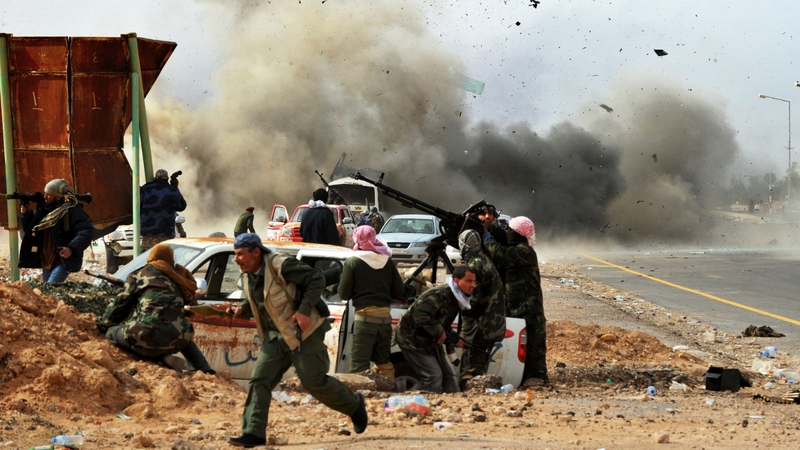
Heavy clashes in Libyan city of Ras Lanuf
Libyan rebels say they have repelled an offensive by Muammar Gaddafi's troops in Ras Lanuf, but have again appealed to foreign powers to impose a no-fly zone to stop further attacks.
Government forces, with air supremacy and a big advantage in tanks, still appear to have regained the momentum and their push could overtake sluggish international efforts to halt Gaddafi.
The sound of explosions and small arms fire were reported around Ras Lanuf as government troops landed from the sea backed by tanks and air power.
After hours of fighting, insurgents withdrew east of the small town and a large column of black smoke was seen billowing from storage tanks at Ras Lanuf's oil installation.
Rebels said the plant was hit by a series of government air strikes, but the Libyan government denied bombing the storage tanks.
There are reports that insurgents then regrouped outside the town, counterattacked and seized it back.
'There has been intense fighting with Gaddafi's forces. They have withdrawn from the residential area to the west. We are now combing the area,' rebel fighter Mohammed Aboul Hassan told Reuters by telephone from Ras Lanuf.
Libyan state television has shown images of a rally which it claimed took place in support of Muammar Gaddafi in the centre of Zawiyah.
The footage, which the station claimed was live, showed hundreds of people in the central square.
However, reports through the day had indicated heavy street fighting in the city, which has changed hands several times in recent days.
Zawiyah residents described scenes of carnage, with women and children among the dead.
UN Humanitarian mission
A UN mission is due to visit Libya tomorrow to evaluate the country's humanitarian needs.
Earlier UN chief Ban Ki-moon said he was dispatching to Libya an envoy, former Jordanian foreign minister Abdul Ilah Khatib, to raise international concerns about Gaddafi's deadly crackdown on protests.
Khatib will put across to the regime 'in no uncertain terms the concerns of the United Nations and the international community.'
The envoy will have a political role in trying to end the conflict but also to try to open up humanitarian access to the Libyan population, Khatib will leave New York at the weekend and arrive in Tripoli early next week.
Abdul Ilah Khatib will be accompanied by senior UN humanitarian officials, UN political advisors and experts from the UN Office of the High Commissioner for Human Rights.
