


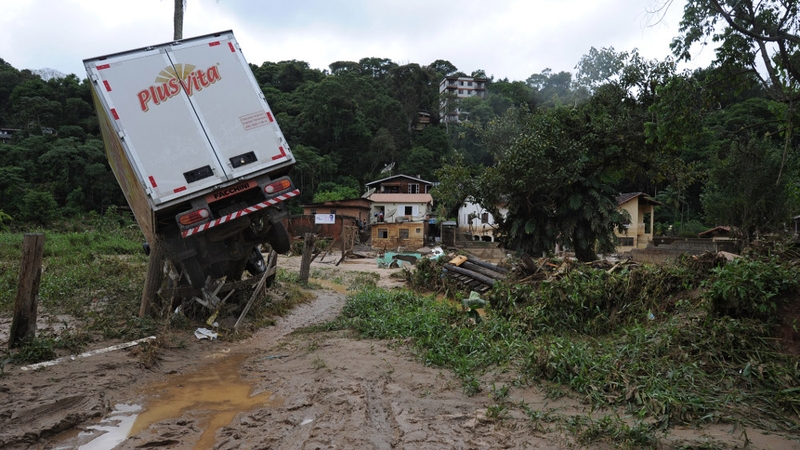
Rescue workers in Brazil are braced for more rain as they struggle to reach areas cut off by floods and landslides, which have killed at least 540 people.
In one of the country's worst natural disasters, rivers of mud have flowed through towns in the mountainous Serrana region outside Rio de Janeiro.
The flood waters have levelled houses, swept away vehicles and stranded thousands of residents.
Emergency shelters have been set up to house displaced families in the worst affected towns such as Teresopolis, where at least 223 people were killed.
The official death toll is 540 people, but rescuers have yet to reach some of the worst-hit parts of Teresopolis, including one neighbourhood where around 150 houses are believed to have been destroyed.
More than 13,500 people have been left homeless. At least 214 people have died in the rural town of Nova Friburgo.
In Petropolis, once the summer residence for Brazil's royal family, 40 people have died, while at least 18 died in Sumidoro.
The flooding has caused billions of euros in damage and has presented President Dilma Rousseff with her first crisis only two weeks after she took office.
Beyond the loss of life and property, the damage from the rains could further boost food prices in parts of southeastern Brazil, a major concern for the government.
The Serrana region is an important producer of fruit and vegetables for the Rio area, but the floods have not affected Brazil's main crops such as soy, sugar cane, oranges and coffee.
Ms Rousseff has earmarked 780m reais (€348m) in emergency aid and briefly visited the region to meet local officials.
The government said it was sending 210 members of the National Public Security Force to help identify bodies.
Hillsides and riverbanks in the area, about 100kms north of Rio, collapsed after the equivalent of a month's rain fell in 24 hours from Tuesday night.
