


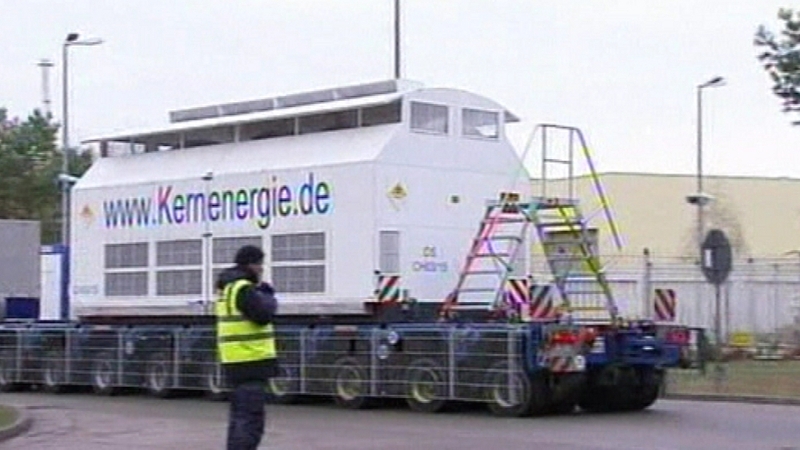
A convoy of highly radioactive waste crawled into its final destination in Germany today after unprecedented anti-nuclear protests.
The 123 tonnes of German waste took 92 hours to make it to the Gorleben storage facility in the north of the country from a processing plant in France, by train and then by road.
Such shipments regularly attract protests. However, this year the delay was the longest ever with demonstrators wishing to display their opposition to government plans to postpone the date when Germany abandons nuclear power.
'(The shipment) may have arrived but the government is further than ever from its aim of getting people in Germany to accept nuclear power,' Florian Kubitz from protest group Robin Wood said.
'We are going to draw new strength from these protests and feel we have been supported by a broad and decisive movement.'
The thousands of protestors did all they could to slow the progress of the convoy.
Protest stunts included sit-ins on the train tracks and the roads, abseiling from bridges into the train's path, removing stones supporting the tracks and even shepherding a herd of sheep and goats into the convoy's path.
Around 20,000 police were deployed in an operation that cost tens of millions of euros, many of them working 24 hours non-stop to remove protestors.
On Sunday, some masked activists fought pitched battles with baton-wielding police enveloped in clouds of tear gas. Protests yesterday and today were mostly peaceful.
'The vast majority of demonstrators were peaceful,' said Uwe Schuenemann, interior minister of Lower Saxony state.
'But if demonstrators used violence against police, officers reacted decisively.'
Germany, in common with other European countries, has no permanent storage site for radioactive waste but is conducting a study to see whether Gorleben, a former salt mine, could be suitable.
Chancellor Angela Merkel wants to extend the lifetime of Germany's 17 reactors by up to 14 years beyond a scheduled shutdown of around 2020 as a 'bridge' until renewable sources like solar and wind power produce more electricity.
Tens of thousands of people demonstrated in Berlin in September against the move.
A survey in September showed 59% of respondents opposed the extension, with just 37% in favour.
'The protests in Gorleben show Angela Merkel has in fact won little with her nuclear policy and lost a lot politically,' the influential news magazine Spiegel said on its website.
