


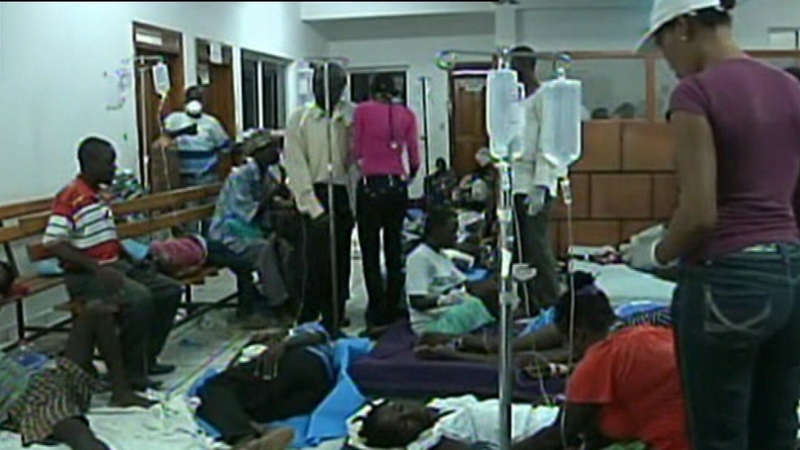
A multinational medical response has slowed deaths in a Haitian cholera epidemic that has killed more than 250 people so far, but the outbreak is likely to widen, a senior UN official said last night.
‘We must gear up for a serious epidemic, even though we hope it won't happen,’ Nigel Fisher, the United Nations humanitarian coordinator in Haiti, told Reuters.
More than 3,000 cholera cases have been reported so far in the Caribbean nation, which is experiencing its second humanitarian crisis since a catastrophic earthquake on 12 January.
The UN, Haiti's government and aid partners have launched a major effort to try to contain the epidemic.
This involved setting up cholera treatment centres to isolate patients in the two worst affected central provinces, Artibonite and Centre, and in the capital Port-au-Prince.
The main outbreak areas straddle the Artibonite River watershed, suspected of being the main propagator of the deadly disease.
‘We have registered a diminishing in numbers of deaths and of hospitalized people in the most critical areas... The tendency is that it is stabilizing, without being able to say that we have reached a peak,’ Gabriel Thimote, director-general of Haiti's Health Department, told a news conference.
With a number of confirmed cases in Port-au-Prince and suspected cases reported in the town of L'Arcahaie and in the country's northern second city of Cap-Haitien, Fisher said the expectation was that the outbreak would spread geographically.
Accumulated deaths since the cholera outbreak began around a week ago stand at 253, while cases total 3,015, mostly in the Artibonite region, Haitian health authorities said.
President Rene Preval yesterday visited Saint-Marc, the coastal town at the centre of the Artibonite outbreak zone whose hospital had been overwhelmed with patients suffering the acute diarrheal disease that can kill in hours through dehydration.
It is transmitted by contaminated water and food.
