

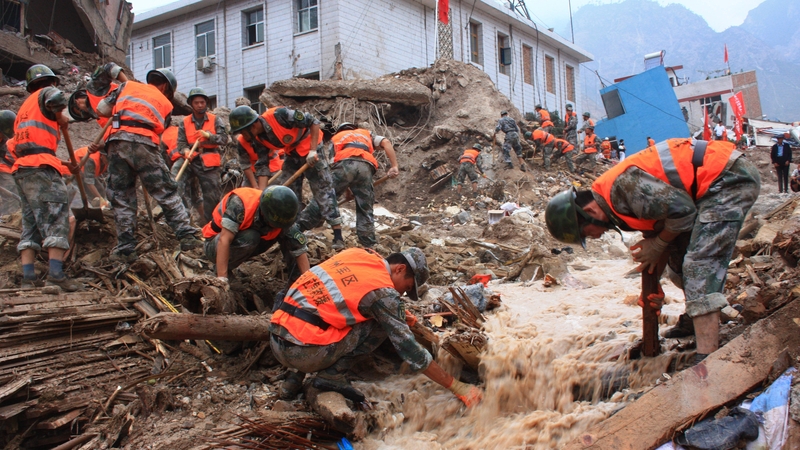
Engineers are battling to drain an unstable lake created by landslides in northwestern China.
They fear it could burst and swamp devastated areas where people are still searching for survivors.
At least 702 people have died and 1,042 are missing in northwestern Gansu province after mud and rocks swept through the small town of Zhouqu at the weekend.
State media said the landslide is the deadliest single incident in a year of heavy flooding that had already killed nearly 1,500.
With rain forecast for the rest of the week, which could further complicate search and rescue efforts, Premier Wen Jiabao urged the thousands of rescuers in hard-hit Zhouqu to hurry, but acknowledged the task would be an arduous one.
'We must fully realise the difficulties for the search and rescue work,' Mr Wen was quoted as saying by Xinhua.
There is no sign of a let-up with tropical storm 'Dianmu' heading for northern China and expected to bring strong rains.
Rapid development
Officials have warned for years that heavy tree-felling and rapid hydro development were making the mountain area vulnerable to flooding and land slips.
Government reports last year urged work to restore a battered line of environmental defences in a brittle landscape, deemed a 'high-occurence disaster zone for landslides'.
Officially, the landslide has been described as a natural disaster brought on by heavy rains, a drought that preceded it, and the huge 2008 earthquake that loosened the riverside slopes in Gannan Prefecture, the mountainous region of southern Gansu.
But government and media warnings about the fragile state of the 576km Bailong River go back years.
Government documents issued before the disaster said the river and its surrounding slopes were prey to manmade problems, as this poor corner of China sought to turn its forests and rivers into economic assets.
The problems are numerous, but widespread tree-felling along the river since the 1950s had caused 'grave destruction to the natural environment, creating serious erosion, worsening geological hazards, frequent natural disasters, a fall in water absorption capacity and shrinking flows.'
An official in the area said that, like other rivers in western China, the Bailong River was over-exploited by rapid hydropower development.
Zhang Qirong, an official with the Bailong River forestry authority, told Reuters that the hydro dams appeared to have been a major factor in unleashing the landslides and clogging the river.
He said more than 13 hydro power stations operate in the stretch of the Bailong coursing through Zhouqu.
