


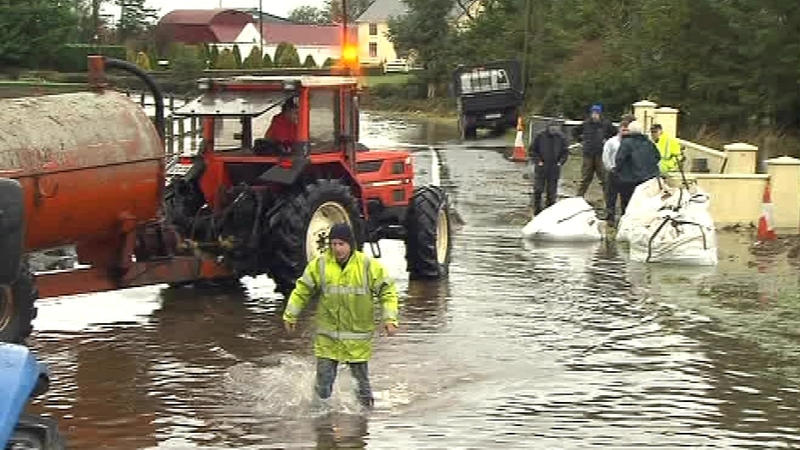
A report on how authorities dealt with severe flooding across the country last November and the prolonged cold spell in January has strongly criticised how the episodes were handled.
The report prepared by the Oireachtas Committee on Environment, Heritage and Local Government says it was not convinced that the State was prepared and able to cope with the severe weather.
Read the full report
It describes the framework under which the Government responds to such emergencies as having some merit, but also says it was complex and confusing with no one person in charge.
The report says the number of State bodies responsible for waterways in Ireland is 'breathtaking' and that serious lessons in communication must be learned.
It also calls for an independent investigation of the opening of the Inniscarra dam on the River Lee by the ESB at the height of the bad weather in November, which worsened flooding in the Lee valley and Cork city.
The report does praise efforts by State agencies, individuals and communities who worked tirelessly during the severe weather to help those worst affected.
The Committee makes several recommendations in its report, including a national programme of road salt procurement and storage for gritting roads.
It also calls for the Office of Public Works (OPW) to prepare a national strategy for river drainage and maintenance.
Local authorities have also been encouraged to develop emergency plans for severe flooding and long spells of cold weather.
The Committee heard from Met Éireann, the ESB, County and City Councils and the Minister for the Environment, John Gormley, among others.
It also visited some of the areas worst affected by the floods.
Cowen satisfied with Govt response
Taoiseach Brian Cowen has said he is fully satisfied with the Government's response during the flooding.
Mr Cowen described the response as 'immediate' and praised emergency services and communities that assisted each other, describing their work as 'outstanding'.
He also said if there are things that could be improved in the future, those lessons can be learnt.
Committee Chairman Séan Fleming said better communications between different authorities would have improved the emergency response to last winter's severe weather.
'There seems to be a distinct lack of clarity regarding who is ultimately in charge of directing the response efforts.
'Too often we found that the various State agencies defined their responsibilities more in terms of what they do not include rather than what they do. This led to a disjointed and confused reaction.'
Fellow committee member, Ciaran Lynch of Labour, said the report has been passed on to Minister Gormley.
Mr Lynch said: 'We were very fortunate that not one life was lost in these extreme events during the winter, but we may not be as lucky next time if the recommendations of this report are not acted upon.'
Rainfall levels for November 2009 were more than twice the normal amount.
Met Éireann said that December 2009 was the coldest for 28 years with widespread frost and falls of heavy snow in many places.
The average daily temperature for much of January 2010 was below zero degrees.
Meanwhile, the ESB has welcomed the committee's report.
In a statement, it said that the company acted at all times in accordance with dam management procedures in order to maximise public safety and alleviate flood damage.
It said the company issued adequate warnings.
