

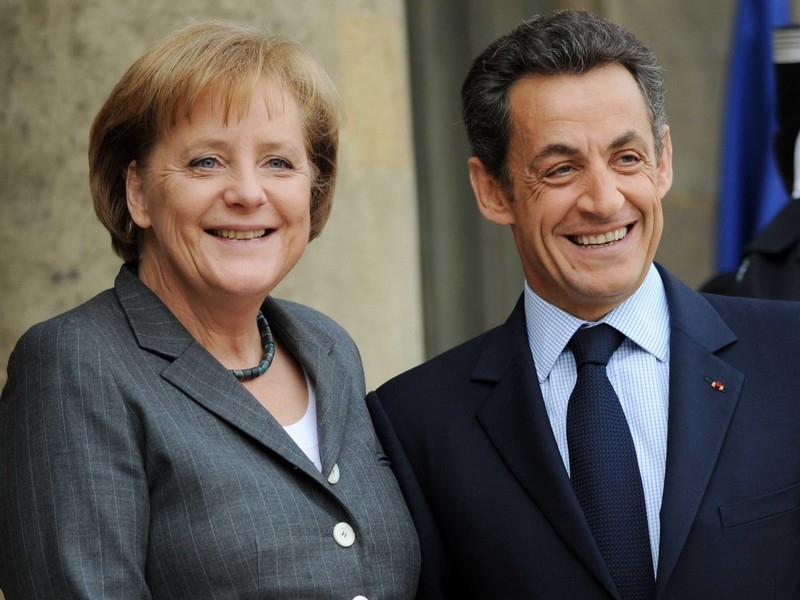
The leaders of France and Germany will seek to overcome deep-rooted disagreements on European economic governance at a meeting in Berlin tomorrow.
The meeting will set the tone for an EU summit later this week.
A show of unity from Berlin and Paris, the motors behind European integration, is seen as crucial for reaching decisions at the summit on Thursday.
Tightened policy co-ordination and the strengthening of budget discipline to contain a debt crisis will be discussed at the summit.
The EU must persuade financial markets the bloc has a common response to the worst crisis to hit the 16-country eurozone since the single currency was created 11 years ago and can prevent Greece's debt problems spreading to other countries.
‘The crisis showed the European system had arrived at its limits: you cannot have a common currency and such gaps in competitiveness,’ a French government source said.
‘You cannot have one country (Germany) where everything is oriented towards gains in productivity and competitiveness and other countries favouring consumption and social protection.
‘Either we manage to come closer or we risk having a political crisis as well as an economic and financial crisis.’
Yet Paris and Berlin are at loggerheads over the correct approach to closer economic governance - so much so that German Chancellor Angela Merkel and French President Nicolas Sarkozy postponed their talks initially scheduled for last week for fear they would be unable to reach an agreement, the source said.
Influential German magazine Der Spiegel said at the weekend Franco-German relations had reached an ‘historic low’.
France's priority is to create an ‘economic government’ for the eurozone - something Germany has resisted - with regular summits of the 16 leaders and a dedicated secretariat, to co-ordinate economic policy and focus on rebalancing the European economy and boosting growth.
Paris has also called for Germany to boost domestic spending in order to balance its huge trade surplus.
Berlin last week launched the biggest austerity drive in Germany since World War II and sees budget discipline as a priority, pressing Paris to implement savings measures.
The German Finance Ministry has circulated a 9-point plan demanding stiffer sanctions against governments that flout European fiscal rules, including suspending repeat offenders' EU voting rights, and an insolvency procedure for states.
Nonetheless, Mr Sarkozy and Ms Merkel went some way to assuaging concerns about a French-German rift last week by issuing a letter to the European Commission calling for faster financial reform and an EU-wide ban on naked short selling of shares and sovereign bonds.
In addition, France looked to anchor its commitment to tighter fiscal policy at the weekend by pledging to cut the budget deficit by €100bn by 2013 and to bring it down to the EU target of 3% of GDP.
