


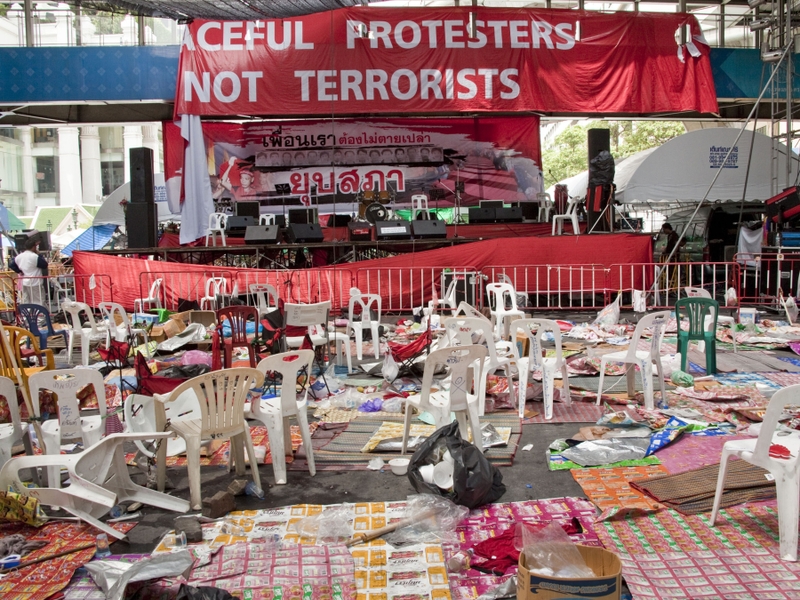
Thailand's prime minister says Bangkok will get back to business tomorrow after a massive clean-up.
Abhisit Vejjajiva has defended a crackdown on protest rallies that unleashed a rampage of arson and looting.
The premier said that schools, streets and government agencies would reopen after being shuttered to keep civilians out of central Bangkok during clashes between security forces and ‘Red Shirts’ protestors.
‘Everything is calm and returning to normalcy,’ he said in his regular Sunday television address, appearing relaxed and confident as two months of crisis that has left 86 dead and 1,900 injured abated.
However, authorities extended a curfew in force for four nights in Bangkok and 23 other provinces, saying the measures would remain in place until Tuesday ‘for security reasons’.
On the streets of Bangkok, a frenzied clean-up was under way to remove tonnes of debris and garbage after Wednesday's offensive on a protest encampment that had paralysed the shopping district for six weeks.
Hordes of workers and volunteers, including foreigners, scraped away political graffiti and posters, wielded power hoses and poured foaming detergent to scrub the streets clean.
Many wore T-shirts printed with a slogan that read ‘Together We Can’ and a heart drawn in the colours of the Thai flag.
Mr Abhisit defended the security authorities' conduct in the final crackdown, which saw 36 major buildings torched when enraged Reds went on the rampage after their leaders were forced to surrender.
‘All weapons use was based on international standards. Weapons were used for self defence and to establish peace and order,’ he said.
The government has displayed a huge cache of weapons it said had been collected from the ruins of the rally encampment, to quash criticism from international rights groups as well as the Reds who said they were unarmed.
However, Mr Abhisit admitted there were serious concerns over fighting at a temple within the Reds camp which had been designated a ‘safe zone’ but where six bodies were found after the chaotic protest dispersal.
‘The most distressing were the deaths at the Pathum Vanaram temple,’ he said, maintaining there was no military action at the time of the shootings but that the events would be investigated by an independent committee.
Concern has been growing over rights abuses in Thailand, with the EU the latest to call on the authorities to respect the rights of protesters and saying the violence had harmed the nation.
Human Rights Watch has also expressed alarm over a ‘draconian’ emergency decree introduced during the crisis to hold prisoners in secret detention.
Mr Abhisit said he would proceed with a reconciliation ‘roadmap’ aimed at healing Thailand's deep divide, but gave no confirmation of the elections that are a key demand of the Red Shirts.
‘I have already said that new elections would only be held after the rallies ended, and on condition that there was peace,’ he said.
Mr Abhisit has admitted that Thailand faces ‘huge challenges’ in the aftermath of the rally campaign by the Reds, who are pushing for the ouster of his government which they see as illegitimate.
The Reds are mostly supporters of former prime minister Thaksin Shinawatra, who was removed in a 2006 coup.
The billionaire was accused of gross rights abuses and corruption, but won grassroots support with his populist policies.
Mr Thaksin's elected allies were later ejected in a controversial court ruling, paving the way for Abhisit's administration to be appointed in a 2008 army-backed parliamentary vote.
