


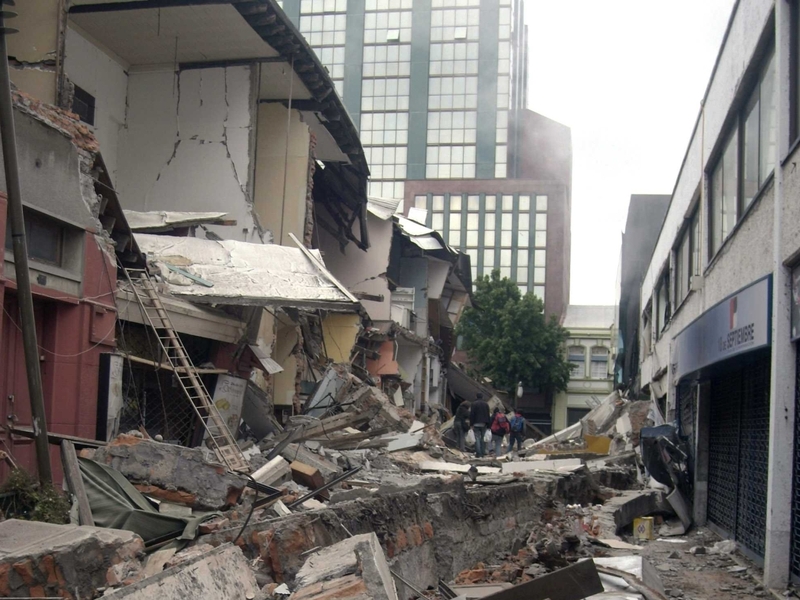
Top Chilean officials are being criticised for failing to warn coastal residents in time that a tsunami was bearing down on them immediately after a devastating earthquake.
Military officials admitted Sunday they had made a mistake in failing to issue an early warning about the possibility of a tsunami after Saturday's 8.8-magnitude quake, one of the biggest ever recorded.
Most of the 800 people killed in the quake are now known to have died as a result of the tsunami, emergency officials said.
The navy has acknowledged that the warning it sent to President Michelle Bachelet lacked clarity.
Officials caught in the middle of the debate raised a fresh tsunami alert yesterday after two powerful new aftershocks struck coastal regions, panicking already traumatised residents.
The alert was dropped after about 20 minutes as a ‘false alarm,’ but by then hundreds of people had fled their homes on foot and in cars heading for higher ground.
It was a further sign of the furious debate about how usual procedures in the quake-prone region managed to break down.
A series of contradictory orders from the president, senior navy officers and the Office of National Emergency in the hours after the earthquake meant a tsunami alert was not immediately raised.
The quake struck in the early hours of Saturday with its epicentre near the city of Concepcion, some 500km south of Santiago.
‘The epicenter is on land, so there should be no tsunami,’ was the information the Chilean navy sent through its Oceanography Service to President Bachelet two hours after the quake.
At that time, Ms Bachelet went on national television to try to calm the public, and said there was no danger of a tsunami.
However, moments later gigantic waves slammed into hamlets like Iloca, Duao, Constitucion and Dichato, hurling fishing trawlers like toys into the streets, destroying buildings and flooding homes, and leaving hundreds dead or missing.
Robinson Crusoe, a small island 700km west of the Chilean mainland, was also hit by giant waves.
‘We were not clear enough in our communication with the presidency, whether to maintain or cancel the alert. There was a hesitation on our part,’ admitted the head of the navy, Edmundo Gonzalez.
‘The truth is that the information was so imprecise and ambiguous that no one could take a decision,’ the head of ONEMI, Carmen Fernandez, responded.
But Ms Bachelet, who said she called the national emergency office several times for information, refused to apportion blame.
‘We are all generals after the battle,’ she told Radio Cooperativa, adding that the tragedy had hit her ‘very hard’ in her final days in office.
President-elect Sebastian Pinera, who takes over on 11 March, has expressed support for Ms Bachelet's handling of the quake aftermath.
Experts said the lines of communication and the usual warning procedures appeared to have broken down.
The navy ‘should have delivered the tsunami alert at the most 10 minutes after the event,’ said a former head of the service, Alfonso Campusano.
The earthquake ‘had to come. It was accumulating a lot of tension (in the fault line) and at some moment it had to be released,’ said geophysicist Marcelo Lagos.
