


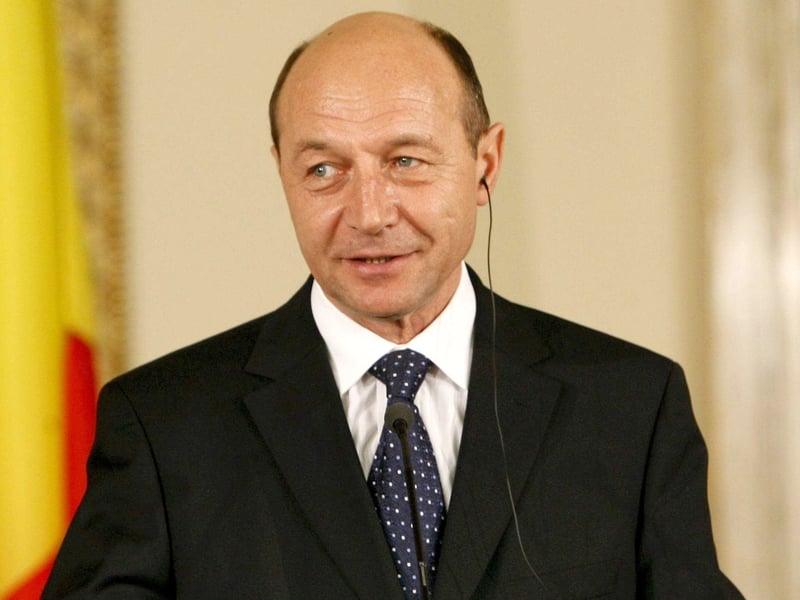
Romanian President Traian Basescu, an outspoken anti-corruption campaigner, has narrowly won re-election, defeating a leftist challenger for the job of leading the EU newcomer out of political and economic crisis.
Mr Basescu scored 50.37% versus 49.63% for Social Democrat leader Mircea Geoana in Sunday's runoff ballot, final results from the Central Election Bureau showed today.
Mr Geoana, who claimed victory as soon as the polls closed, did not immediately concede defeat.
But his designated candidate for prime minister, Klaus Johannis, appeared to accept the outcome, telling a news conference: ‘My road ends here.’
Analysts said the abrasive Basescu may struggle to form a government with other major parties with which he repeatedly clashed over anti-corruption measures during his five-year term.
Late Sunday, most exit polls put Mr Geoana ahead in the tight election that the candidates labeled the most important since the fall of communism 20 years ago.
Just after polling stations closed on Sunday, the Social-Democrat candidate, a former diplomat who has pledged to ‘reunite’ Romania after years of political squabbling, loudly claimed victory in front of his supporters.
But Mr Basescu insisted he was the winner, telling his supporters: ‘I have won. I assure you that the correct exit polls show that I have beaten Mircea Geoana.’
The Organisation for Security and Cooperation in Europe (OSCE), which deployed a limited monitoring mission, will publish its report later today.
‘We do not have any evidence proving massive fraud so far,’ Cristian Parvulescu, head of non-governmental organisation Pro Democratia, said.
Romanians went to the ballot box hoping for an end to a political standoff that has held up crucial international aid for the recession-wracked country.
The new president will have no time to lose in appointing a prime minister in order to unlock aid from a €20bn bailout plan from the International Monetary Fund, the European Union and the World Bank.
The country has been led by a caretaker government since October.
