


Ceremonies were held around the world today to mark Armistice Day, the end of the First World War in 1918.
View our Armistice Day gallery
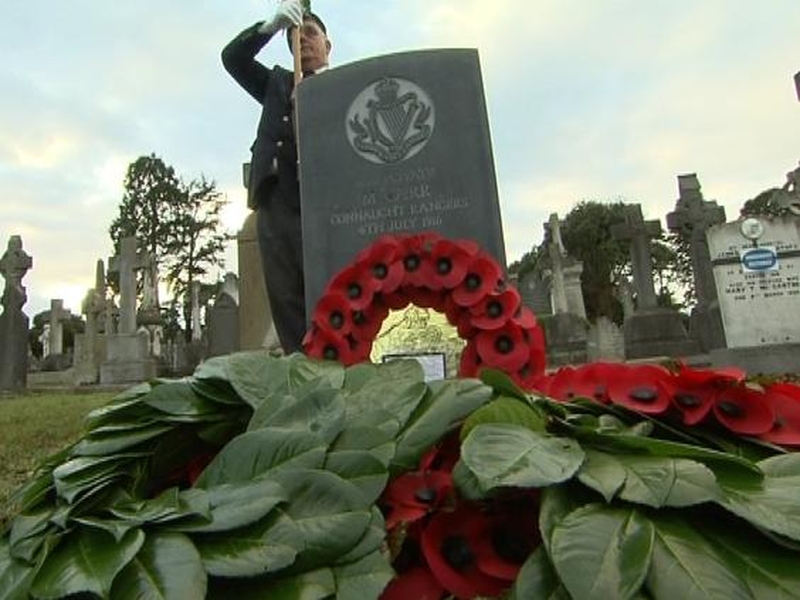
In Dublin, a commemoration was held in Glasnevin Cemetery to erect headstones for the first time for Irish servicemen who died from injuries sustained in the two world wars while serving for commonwealth forces.
Until now Martin Carr, who died after fighting with the Connaught Rangers in World War One, was buried in unmarked grave 48 1/2.
Today, his resting place was marked by a headstone.
Members of the British and Irish governments joined in honouring the Irish war dead along with Thomas Goff and Leo Connolly of the Royal Dublin Fusiliers and Michael Kavanagh who fought with the Royal Artillery in World War II.
Today also marks another shift in healing old wounds between Britain and Ireland, especially for those servicemen who returned after World War One to find a changed Ireland in the wake of the Easter Rising.
It is estimated that more than 350,000 Irish people fought during World War I, with the Irish death toll put at more than 30,000.
France and Germany held a joint Armistice Day ceremony for the first time as events around the globe honoured the millions killed in World War I.
In London, Queen Elizabeth II led tributes to the war dead, including the growing number of soldiers killed in Afghanistan. But the last British veteran of the 1914-18 conflict boycotted official events.
President Nicolas Sarkozy and Chancellor Angela Merkel rekindled the flame on the tomb of the Unknown Soldier at the foot of the Arc de Triomphe in a symbolic appearance intended to signal a new phase in Franco-German relations.
It was the first time a German leader has taken part in a French Armistice Day parade.
The event comes just two days after Mr Sarkozy visited Berlin to attend celebrations marking the 20th anniversary of the fall of the Berlin Wall.
German leaders have attended Armistice Day events in France before, most notably when Chancellor Helmut Kohl took President Francois Mitterrand's hand in Verdun, the scene of one of the fiercest battles of the 1914-18 war.
But Ms Merkel's visit is the first time a German leader has attended the Paris ceremonies marking the surrender of Germany after four years of trench warfare that left millions dead.
The two leaders observed a short moment of silence at the Arc de Triomphe, flanked by soldiers from a Franco-German Brigade and officers from both countries' armed forces.
Of the eight million British soldiers who fought in WWI, only 108-year-old Royal Navy veteran Claude Choules, who lives in Perth, Australia, remains alive.
But he stayed away from official events events in his adopted land.
'After my father left the navy, he never went to ANZAC Day again,' Edinger told Fairfax media, referring to the day Australians and New Zealanders remember their war dead. 'He didn't think we should glorify war.'
The last three veterans of World War I living in Britain died this year. The last US veteran is Frank Buckles, 108, while Canadian John Babcock also survives.
Today's silence - at the 11th hour of the 11th day of the 11th month - marks the moment 91 years ago when the guns fell silent across Europe after Germany signed an Armistice Treaty with its Allied foes.
Much of the fighting, which left around 10m dead, happened in northern France and was characterised by horrific trench warfare.
