

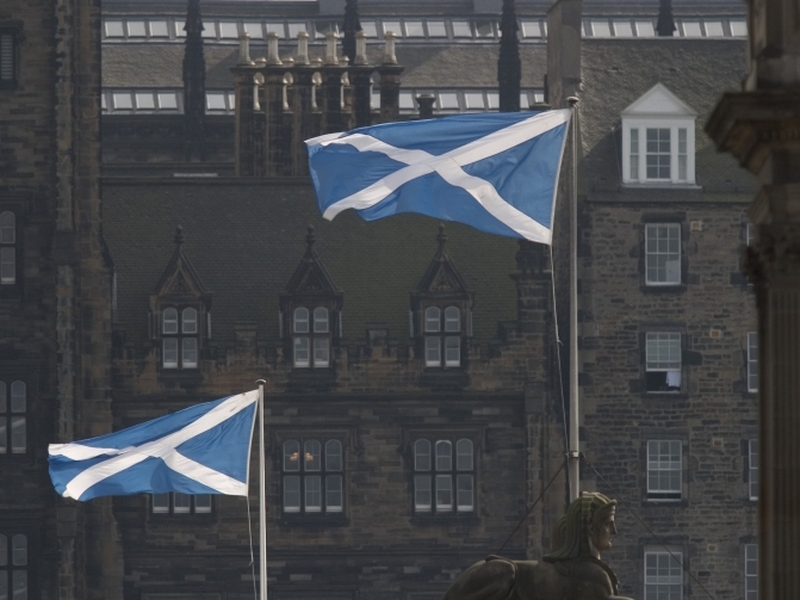
G20 finance ministers made little progress on a deal on the cost of climate change but did launch a new framework aimed at rebalancing the global economy.
At a meeting in St Andrews, Scotland, Britain pressed the G20 to come up with a plan to make banks pay for any future bailouts but one idea of imposing a global financial transactions tax was immediately shot down by the US.
The group committed to present detailed economic plans for each other to check by the end of January 2010 to ensure better policy coordination.
And they agreed it was too early to pull the plug on emergency economic support packages because the recovery from the global recession was uneven and dependent on ultra-low interest rates and the trillions of dollars thrown at the problem.
‘We are not out of the woods yet,’ British finance minister Alistair Darling said when the meeting ended.
British Prime Minister Gordon Brown urged the G20 in St Andrews to consider the bank bailout fund urgently.
France and Germany have been in favour for some time of looking at a levy but London with its huge financial centre has always resisted.
The question remains what sort of scheme could be agreed, with the US also having resisted such measures.
US Treasury Secretary Timothy Geithner said a day-to-day transaction tax was not something Washington would be prepared to support but also pointed to other ways in which banks could be made to contribute to the costs of future bailouts.
Canada Finance Minister Jim Flaherty also sounded doubtful about the tax: ‘It's one of the ideas that's on the table, but is not particularly attractive to me. We have been a government that has been reducing taxes.’
Mr Brown said the International Monetary Fund would review the possibility of a global levy and report back in April next year and that any measures would have to be globally implemented for Britain to go along.
Meanwhile, France says it wants to see genuine signs of progress on curbs on bankers' bonuses after the leaders agreed in Pittsburgh to move towards a system of spreading them over a longer period with the possibility of clawing back payments if they under-perform.
Finance minister Christine Lagarde told BBC radio: ‘I would hope that a little bit more can be done, to actually cast in stone the fact that we want to stop excesses, stop abuses, and bonuses that are strictly risk incentives.’
Bonus policies have been blamed by many observers for fuelling last year's instability in financial markets, amid claims they encourage excessive risk-taking.
As a handful of protestors gathered in St Andrews to target the meeting, anti-poverty campaigners called for ministers to take action to help people in developing countries, notably by acting on climate change.
Forty leaders plan to attend climate talks-UN
About 40 world leaders plan to go to Copenhagen next month to improve the chances of clinching a UN climate deal, the United Nations said on Friday as preparatory talks ended with scant progress.
Developing nations in Barcelona accused rich countries of trying to lower ambitions for a 190-nation deal in Copenhagen with suggestions that up to an extra year may be needed to tie up details of a legally binding treaty.
Inviting world leaders to the end of the Copenhagen meeting on December 7-18 could help overcome disputes, said Yvo de Boer, head of the UN Climate Change Secretariat, on the final day of the week-long Barcelona talks.
German Chancellor Angela Merkel is considering attending, a spokesman said in Berlin. US President Barack Obama is among those undecided.
Danish Prime Minister Lars Lokke Rasmussen has not formally invited leaders to the talks, currently due to be limited to environment ministers. ‘There is no official figure’ of how many leaders will come, a Danish spokesman said.
The 175-nation Barcelona meeting ended with little progress towards a deal but narrowed options on helping the poor to adapt to climate change, sharing technology and cutting emissions from deforestation, delegates said.
The meeting exposed a continuing rich-poor split on sharing the burden of curbs on greenhouse gas emissions in a drive to avert droughts, wildfires, species extinctions and rising seas.
It also opened a new rift on what was achievable in Copenhagen. Rich nation delegates said there was time to agree in December a ‘political deal’, followed by a legal text six to 12 months later.
Activists criticised a lack of leadership in the run-up to Copenhagen, including from President Obama.
