


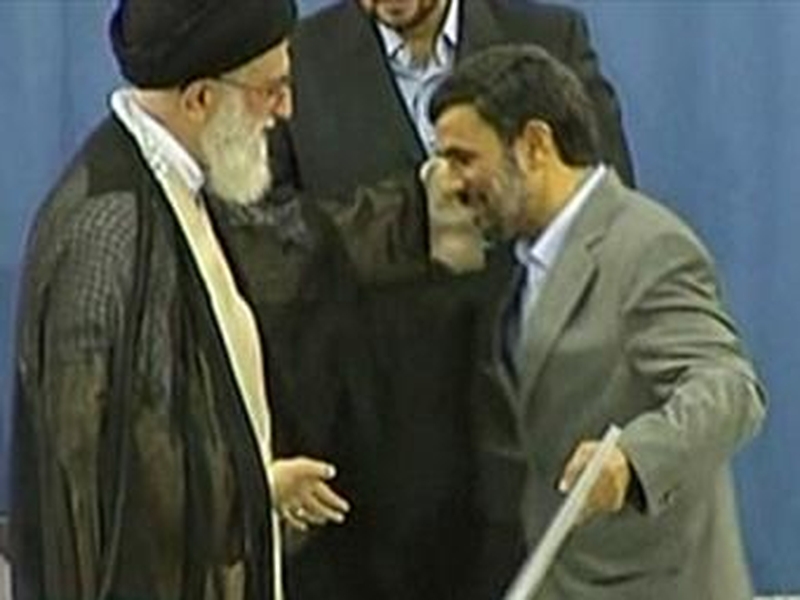
Iran's supreme leader Ayatollah Ali Khamenei has endorsed Mahmoud Ahmadinejad as president despite widespread dispute over the hardliner's re-election for a second term.
Supreme Leader Ayatollah Ali Khamenei has demanded an end to protests during which at least 20 people were killed.
Moderate defeated candidates Mirhossein Mousavi and Mehdi Karoubi say the next government will be illegitimate.
Iranian officials deny any fraud in the election, in which Mr Ahmadinejad was declared to have won 63% of 40m votes cast, against 34% for Mr Mousavi.
Mr Ahmadinejad will be sworn in by parliament on Wednesday.
He then has two weeks to submit his cabinet list to the mostly conservative parliament, which may object if he names only members of his inner circle.
The aftermath of the election has also exposed deep schisms within Iran's clerical and political elite.
Some 100 moderates and Mousavi supporters went on trial on Saturday on a range of charges, including acting against national security, punishable by death under Iran's Islamic law.
The mass trial of reformists, including several senior officials, has no precedent in revolutionary Iran's 30-year history.
Leading moderates, including former president Mohammad Khatami, have rejected what they say is a show trial and said some defendants had made confessions under duress.
Many of the defendants had spent weeks in jail without access to lawyers, Mr Mousavi said yesterday, adding that the trial was 'an awkward preparation' for the start of Mr Ahmadinejad's second term.
Even some hardliners have criticised the trial and the official portrayal of the protestors as people determined to overthrow Iran's system of government.
Iranian media have said the charges include rioting, attacking military and government buildings, having links with armed opposition groups and conspiring against the ruling system.
Some defendants, including Khatami's vice-president Mohammad Ali Abtahi, told the court that they were wrong to have said the vote was fraudulent.
Mr Karoubi said in a statement today that the trial's only effect would be to harm the clerical establishment.
'Such trials and confessions taken under pressure will discredit the system. It will tarnish the image of the Islamic Republic', Mr Karoubi's website quoted him as saying.
