


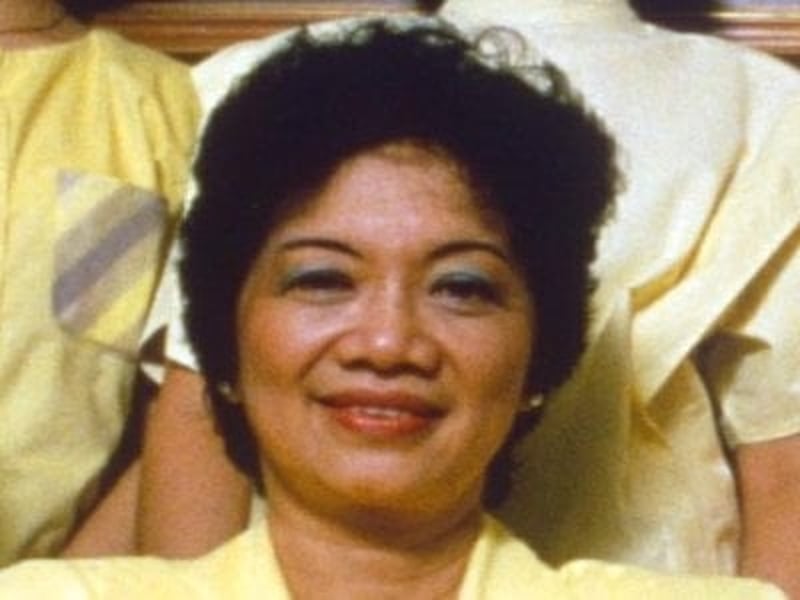
Tributes have been paid to Corazon Aquino of the Philippines, who has died after a 16-month battle against colon cancer.
Her family announced she died shortly after a private mass was held in her hospital room surrounded by her five children. She was 76.
‘Our mother peacefully passed away at 3.18am 1 August (7.18 Irish time Friday) of cardio-respiratory arrest,’ her son, Senator Benigno Aquino Jr., said.
Mrs Aquino, known as Cory to millions of Filipinos, was president from 1986 to 1992.
But she is remembered, more than two decades after the fact, as the slim woman in yellow who led the ‘People Power’ revolution that toppled dictator Ferdinand Marcos.
The tumultuous events of those weeks in 1986, which came to a head when up to 1 million people waving rosaries and flowers stopped Marcos' tanks advancing towards Aquino-backed army rebels, became a fairy-tale revolution that gripped the world.
As news of Mrs Aquino's death spread, hundreds of people began visiting her home and the EDSA shrine where her 1986 revolution culminated, leaving flowers and lighting candles. Many tied yellow ribbons to their cars, and on trees near her home.
Current president Gloria Arroyo declared a 10-day period of mourning.
Mrs Aquino was a reluctant leader at the start. She shed the housewife's apron only after her politician husband Benigno was assassinated at Manila's international airport in 1983 on his return from exile in the US.
Accusing president Marcos of ordering the murder, Mrs Aquino led protest marches, but was hesitant when elections were called in 1986.
Both candidates claimed victory in the election, but Marcos fled into exile when the army turned against him.
Mrs Aquino's presidency was less successful than the revolution, with a series of coup attempts by the military keeping the administration hamstrung.
She was lauded for her courage, but rarely seemed able to get on top of ruling the country.
The spectre of army intervention haunted her entire rule. Natural disasters, including Mount Pinatubo's huge volcanic eruption in 1991, severely battered the economy.
A devout Catholic, Mrs Aquino often turned to her faith to steer her through difficult times.
‘There was never any moment that I doubted God would help ... If it was time to die, so be it,’ she said when rebel mortars pounded the presidential palace in 1987.
Although she seemed frail in later years, she was still game for a fight when she thought it necessary. She brought half a million people onto the street in the 1990s when her successor Fidel Ramos flirted with the idea of trying to extend his term in office.
She was involved in protests that ended the presidency of Joseph Estrada in 2001, and has supported the campaign to remove current President Gloria Macapagal Arroyo after her one-time ally was accused of corruption and election fraud.
President Arroyo, who is in the US on a visit, announced a 10-day period of national mourning and said in a message: ‘Today the Philippines lost a national treasure. She helped lead our nation to a brighter day.’
US President Barack Obama said: ‘Her courage, determination, and moral leadership are an inspiration to us all and exemplify the best in the Filipino nation.’
Mrs Aquino's family has opted against a state funeral and plan to bury her beside her husband after a private ceremony on Wednesday.
