


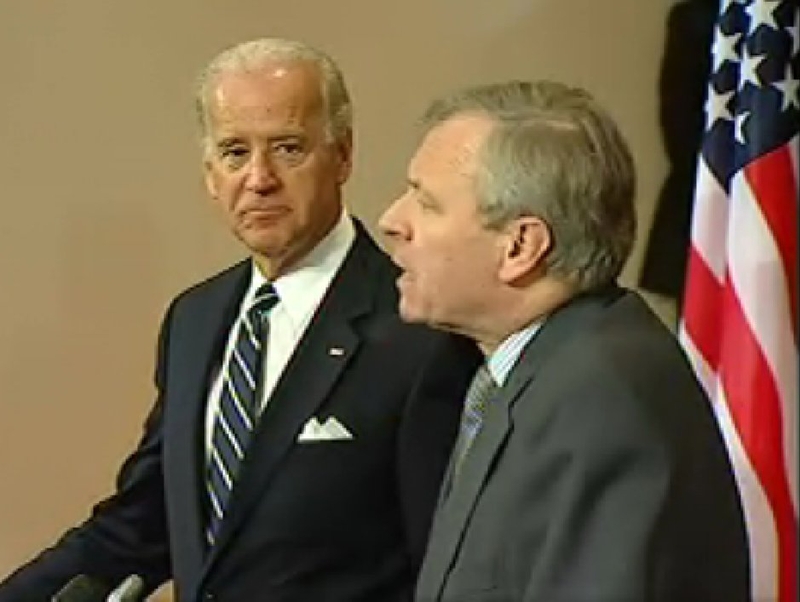
US Vice President Joe Biden has appealed to NATO allies for help tackling the 'deteriorating situation' in Afghanistan.
'(It) poses a security threat not just to the United States but to every single nation round this table,’ Mr Biden told representatives of the 26-nation military pact during a visit to Brussels today.
‘It was from the very same mountains that the attacks of 9/11 were planned,’ he said.
US-led forces drove the Taliban from power in Kabul in response to the 11 September, 2001, attacks on US targets planned by Osama bin Laden from bases in Afghanistan.
Western powers are increasingly concerned by the Taliban's advances in the border regions in both Afghanistan and Pakistan.
Islamic militants have disrupted NATO's supply convoys to Afghanistan and are securing concessions from the government in Islamabad.
Mr Biden said US President Barack Obama wanted to consult with allies on a strategy review for the region and that Washington would ‘expect everyone to keep whatever commitments were made in arriving at that joint strategy’.
President Obama last month approved the deployment of 17,000 more troops to Afghanistan as Washington and other NATO nations try to stabilise the country, where insurgent violence is at its highest since the Taliban were toppled.
There are currently some 70,000 foreign troops in Afghanistan, of which the US supplies 38,000.
Just listening
Vice President Biden said his trip to Brussels was intended simply to listen to US allies, who faced calls by the former Bush administration to deploy more troops in what often became noisy transatlantic slinging matches over strategy.
‘When we consult ... we get the type of consensus that our political leadership needs,’ Mr Biden said. ‘Absent that kind of cohesion, it will be incredibly more difficult to meet the common threats we are going to face.’
A senior US administration official said Biden would not be making requests for troops but wanted to hear ideas.
‘He will be saying: 'we want to hear your ideas and if you don't like what we're saying, we want to hear concrete alternatives',’ the official said.
‘We are aware obviously that not every country is able to contribute more troops than they have already, but there are different kinds of assistance ... whether it's troop specific or civil institution building.’
The official said non-military assistance included help for police training. This is an issue Mr Biden is expected to raise with EU officials later.
The EU runs a programme for training the Afghan police but has failed so far to provide pledged trainers, despite promising last year to double their number.
President Obama has said he will make announcements about US policy on Afghanistan before a NATO summit in France in April.
The policy review is expected to stress the need for better coordination of the international effort and enhanced efforts in areas like police training, governance and development as well as a regional approach involving Afghanistan's neighbours - aims the allies have been flagging for years.
Obama offer rejected
The Taliban in Afghanistan turned down a bid by US President Barack Obama to reach out to moderate elements of the insurgents.
It said the exit of foreign troops was the only solution for ending the war.
Mr Obama, in an interview with The New York Times, expressed an openness to adapting tactics in Afghanistan that had been used in Iraq to reach out to moderate elements there.
‘This does not require any response or reaction for this is illogical,’ Qari Mohammad Yousuf, a purported spokesman for the insurgent group, said when asked if its top leader Mullah Mohammad Omar would make any comment about Mr Obama's proposal.
‘The Taliban are united, have one leader, one aim, one policy ... I do not know why they are talking about moderate Taliban and what it means?’
‘If it means those who are not fighting and are sitting in their homes, then talking to them is meaningless. This really is surprising the Taliban.’
In Iraq, the use of Sunni Muslim community leaders to employ their people to patrol their neighbourhoods has been credited as one of the main reasons behind sharp falls in violence.
The number of foreign troops in Afghanistan has risen steadily since the Taliban refused to hand over al-Qaeda leaders responsible for the 11 September 2001 attacks on the US.
So has the level of Taliban attacks against the government and foreign forces, prompting Mr Obama to term Afghanistan as a top foreign policy priority for his new administration.
Some Western politicians and military officers now say the war cannot be won by military means alone and a solution will have to involve some form of reconciliation.
Mr Yousuf said expulsion of foreign troops was the only solution for Afghanistan's spiraling violence.
‘Afghans know better how to decide about their destiny,’ he replied when asked if the Taliban were willing to hold talks with Mr Karzai's government if and when the troops leave.
